Net Metering Changes 2026: Residential Solar Impact Explained

Understanding Net Metering Changes: Impact on Residential Solar in 2026
The solar energy landscape is constantly evolving, driven by technological advancements, economic shifts, and crucial policy decisions. Among the most significant policies affecting residential solar adoption is net metering. For years, net metering has been a cornerstone of the solar industry, incentivizing homeowners to invest in solar panels by crediting them for excess electricity sent back to the grid. However, as we approach 2026, significant net metering 2026 changes are on the horizon, promising to reshape the financial calculus for residential solar installations across various regions. This comprehensive guide will delve into what these changes entail, their potential impact on homeowners, and how you can navigate the evolving regulatory environment to continue harnessing the power of the sun.
What is Net Metering and Why is it Changing?
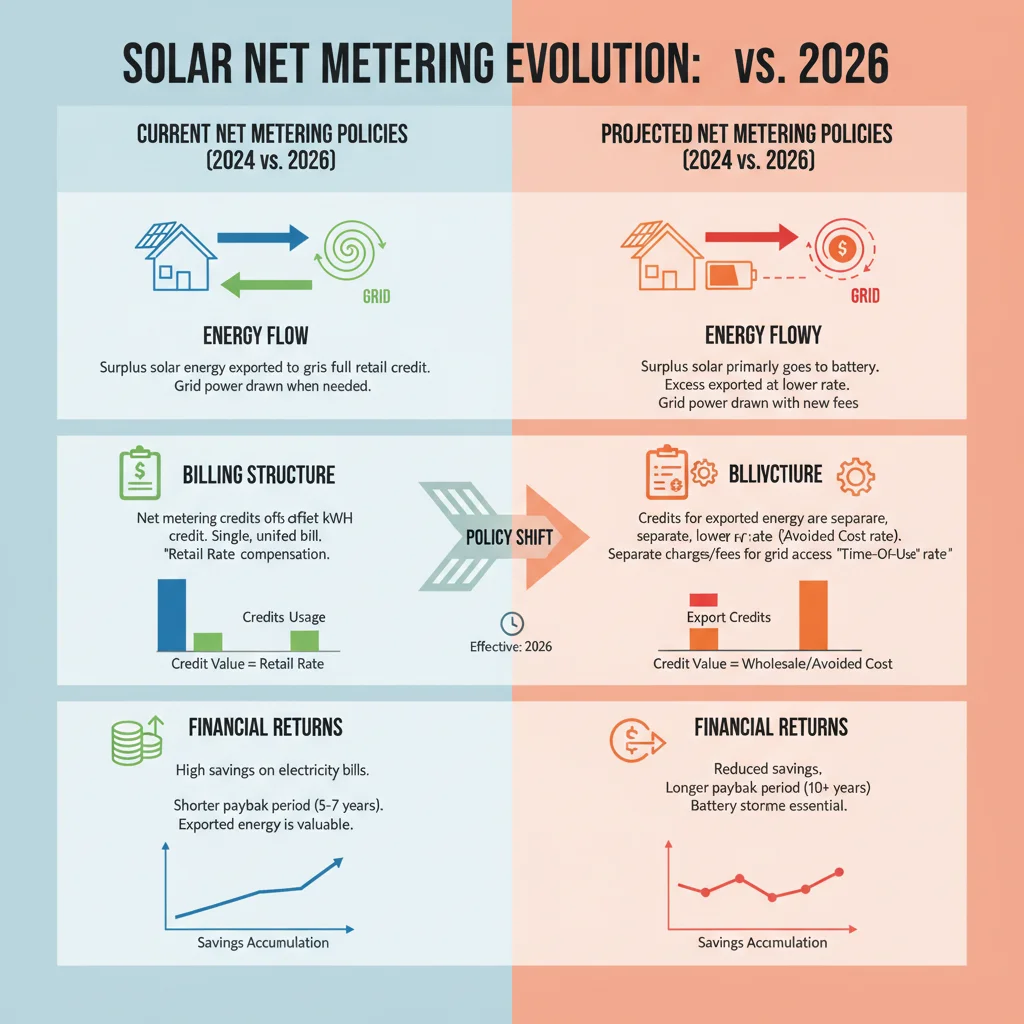
To fully grasp the implications of the upcoming net metering 2026 modifications, it’s essential to understand the basics of net metering. In its simplest form, net metering is a billing mechanism that credits solar energy system owners for the electricity they add to the grid. When your solar panels produce more electricity than your home consumes, the excess power is exported to the utility grid. Under traditional net metering, you receive a credit on your electricity bill, typically at the full retail rate, for this exported power. When your solar panels are not producing enough electricity (e.g., at night or on cloudy days), you draw power from the grid and are billed for it. At the end of the billing cycle, you only pay for your ‘net’ consumption – the difference between the electricity you consumed from the grid and the electricity your solar system sent back to it.
This system has been incredibly effective in promoting solar adoption. By ensuring a fair value for exported solar energy, net metering has made solar installations financially attractive, significantly reducing the payback period and increasing the return on investment for homeowners. It effectively turns your electricity meter backward, allowing you to use the grid as a giant battery for your excess solar production.
Why the Shift? The Drivers Behind Net Metering 2026 Changes
The reasons behind the impending net metering 2026 changes are multifaceted and often contentious. Utilities argue that current net metering policies place an unfair burden on non-solar customers. Their primary claims include:
- Grid Maintenance Costs: Utilities maintain the electrical grid, which requires significant investment in infrastructure, maintenance, and upgrades. They argue that solar customers, by reducing their reliance on grid electricity and even receiving credits, are not contributing their fair share to these fixed costs, leaving non-solar customers to pick up the tab.
- Cost Shifting: This is perhaps the most significant point of contention. Utilities suggest that net metering leads to ‘cost shifting,’ where the fixed costs of maintaining the grid are spread across a smaller base of non-solar customers, leading to higher rates for them.
- Evolving Grid Needs: As more solar energy comes online, managing the grid becomes more complex. The intermittent nature of solar power requires advanced grid management technologies and potentially more reserve capacity, costs that utilities argue should be partly borne by solar producers.
- Technological Advancements: The rise of home battery storage systems is changing the dynamics. With batteries, homeowners can store excess solar energy for later use, reducing their reliance on the grid and potentially altering the value proposition of exporting power.
On the other hand, solar advocates argue that solar energy provides numerous benefits to the grid and society as a whole, including reduced peak demand, lower transmission losses, improved air quality, and energy independence. They contend that these benefits are often undervalued or not fully accounted for in utility rate design, and that weakening net metering policies could stifle solar growth and hinder progress towards a cleaner energy future.
The Anticipated Landscape of Net Metering in 2026
While the exact nature of net metering 2026 changes will vary by state and utility, several common themes and potential policy shifts are emerging. These changes generally aim to reduce the export credit rate, introduce new charges, or alter the overall compensation structure for solar homeowners.
Common Changes Expected:
- Reduced Export Compensation: The most prevalent change is a move from full retail rate compensation to a lower rate for exported electricity. This could be based on the utility’s avoided cost (the cost the utility avoids by not having to generate that power itself), wholesale rates, or a specific value of solar tariff. This means that for every kilowatt-hour (kWh) you send back to the grid, you might receive significantly less credit than what you pay for electricity drawn from the grid.
- Introduction of Fixed Charges or Demand Charges: Some utilities may introduce new fixed charges or increase existing ones for solar customers. Demand charges, which bill customers based on their highest electricity usage during a specific period (even if for a short time), could also become more common, particularly for larger residential systems.
- Time-of-Use (TOU) Rates: More widespread adoption of Time-of-Use rates is anticipated. Under TOU rates, the price of electricity varies depending on the time of day, week, or season. This means that the value of your exported solar energy could depend on when you send it to the grid, incentivizing self-consumption during peak demand hours.
- Capacity-Based Charges: Some proposals include charges based on the size of your solar system’s inverter, regardless of actual energy consumption or export.
- Grandfathering Clauses: A critical aspect for existing solar owners is whether new policies will apply to them. Many states implement ‘grandfathering’ clauses, which allow existing solar installations to remain on their original net metering terms for a specified period (e.g., 10-20 years) before transitioning to new rules. However, the specifics of these clauses vary widely.
It’s crucial for homeowners to stay informed about the specific proposals and decisions in their state and utility service area, as the regulatory landscape is highly localized.
Impact on Residential Solar Installations
The net metering 2026 changes will undoubtedly have a profound impact on the economics of residential solar. While solar will likely remain a sound investment, the financial benefits may shift, requiring homeowners to adopt new strategies.
Financial Implications for Homeowners:
- Longer Payback Periods: With reduced compensation for exported electricity, the time it takes for a solar system to pay for itself through energy savings will likely increase.
- Lower Return on Investment (ROI): The overall financial return on a solar investment may decrease compared to current net metering regimes.
- Increased Importance of Self-Consumption: Maximizing the amount of solar energy you use directly in your home rather than exporting it will become more critical. This means running high-energy appliances during peak solar production hours.
- Complex Billing: New rate structures, including TOU rates and demand charges, can make electricity bills more complex to understand and manage.
Potential for Reduced Solar Adoption:
Critics of net metering changes argue that significantly reducing the financial incentives for solar could slow down the adoption rate of residential solar. If the economic benefits diminish substantially, fewer homeowners might be inclined to make the upfront investment, potentially hindering renewable energy goals.
The Rise of Energy Storage:
Perhaps the most significant shift expected due to net metering 2026 changes is the increased attractiveness of home battery storage. When export compensation is low, storing excess solar energy for later use (e.g., at night or during peak TOU periods) becomes a more economically viable strategy. Batteries allow homeowners to:
- Maximize Self-Consumption: Store excess daytime solar production to power your home during the evening, reducing reliance on grid electricity when rates might be higher.
- Arbitrage TOU Rates: Charge batteries when electricity prices are low (e.g., with cheap off-peak grid power or excess solar) and discharge them when prices are high.
- Gain Energy Resilience: Provide backup power during grid outages, offering an additional layer of security and independence.
The cost of battery storage is decreasing, making it an increasingly accessible option for homeowners looking to optimize their solar investment under new net metering rules. This shift could transform residential solar from primarily an export-driven model to a self-consumption and storage-focused model.
Strategies for Homeowners to Prepare for Net Metering 2026
Even with the impending net metering 2026 changes, residential solar remains a powerful tool for energy independence and environmental stewardship. The key is to adapt and strategize effectively. Here are several approaches homeowners can consider:
1. Act Early (If Grandfathering is an Option):
If your state or utility offers grandfathering provisions for existing net metering customers, installing your solar system before the new policies take effect could allow you to lock in more favorable terms for many years. This is a critical factor for homeowners currently considering solar.
2. Optimize for Self-Consumption:
Under new net metering rules, the value of consuming your own solar power directly will often be higher than exporting it. Consider these strategies:
- Time Your Appliance Usage: Run energy-intensive appliances like dishwashers, washing machines, and electric vehicle chargers during the sunniest parts of the day when your solar panels are producing the most power.
- Energy Efficiency Upgrades: Reduce your overall energy consumption through energy-efficient appliances, improved insulation, and smart home technologies. The less electricity you need to buy from the grid, the more you save.
3. Invest in Battery Storage:
As discussed, battery storage is becoming an increasingly compelling addition to residential solar systems. It allows you to store excess solar production for use during peak demand hours or at night, maximizing the value of your self-generated electricity and reducing your reliance on grid purchases. Evaluate the costs and benefits of battery storage for your specific situation.
4. Understand Your Utility’s Rate Structure:
Familiarize yourself with your utility’s current and proposed rate structures, especially Time-of-Use (TOU) rates and any potential demand charges. This knowledge will help you make informed decisions about energy consumption and potential battery integration.
5. Explore Other Incentives:
While net metering policies are changing, other federal, state, and local incentives for solar and battery storage may still be available. The federal Investment Tax Credit (ITC) for solar and storage, for example, remains a significant financial driver. Research all available incentives to maximize your overall savings.
6. Choose a Reputable Solar Installer:
Work with an experienced and knowledgeable solar installer who can design a system optimized for the new net metering rules in your area. They can advise on system sizing, battery integration, and smart energy management solutions to ensure your investment provides the best possible return.
The Broader Implications for the Solar Industry
The net metering 2026 changes are not just about individual homeowners; they have broader implications for the entire solar industry and the transition to a clean energy future. While some fear a slowdown in solar growth, others see these changes as an impetus for innovation.
Innovation in Solar Technology:
The shift away from full retail net metering is likely to accelerate the development and adoption of technologies that enhance grid independence and self-consumption. This includes more efficient solar panels, advanced inverters, smarter energy management systems, and, most notably, more affordable and capable battery storage solutions.
New Business Models:
Solar companies may adapt their business models to focus more on bundled solar-plus-storage solutions, virtual power plants (VPPs) where aggregated home batteries can provide grid services, and energy management services that help homeowners optimize their energy usage under complex rate structures.
Policy Advocacy:
The ongoing debate over net metering highlights the critical role of policy advocacy. Solar industry groups, environmental organizations, and consumer advocates will continue to engage with policymakers to ensure that future energy policies fairly value distributed solar generation and support the transition to a sustainable energy system.
It’s important to remember that the energy landscape is dynamic. While these changes may present challenges, they also drive innovation and push the industry towards more resilient and self-sufficient energy solutions.

Case Studies and Regional Variations
To illustrate the potential impact of net metering 2026 changes, it’s helpful to look at regions that have already implemented similar policies. California’s NEM 3.0, for instance, significantly reduced export compensation and increased fixed charges, leading to a substantial increase in solar-plus-storage installations and a decrease in solar-only projects. This provides a blueprint for what other states might experience.
Other states have adopted different approaches, such as valuing solar based on its contribution to grid reliability or avoided generation costs. These diverse approaches underscore the importance of understanding your local regulatory environment.
Key Takeaways from Early Adopters of Reduced Net Metering:
- Battery Storage Becomes Essential: In regions with lower export rates, battery storage quickly moves from a luxury to a near-necessity for maximizing solar savings.
- System Sizing Changes: Homeowners and installers may opt for systems sized to match consumption more closely, rather than oversizing to generate significant export credits.
- Focus on Energy Efficiency: The emphasis on reducing overall energy demand intensifies, as every kWh not consumed means less reliance on potentially expensive grid power.
- New Financing Models: The financial products available for solar may also evolve, with more integrated solar-plus-storage financing options.
As 2026 approaches, more states and utilities are likely to announce their specific plans. Staying informed through local solar advocacy groups, utility websites, and reputable solar installers will be crucial for homeowners.
The Future of Residential Solar Beyond 2026
While the net metering 2026 changes represent a significant hurdle for the solar industry, they are also part of a larger evolutionary process. The long-term outlook for residential solar remains positive, driven by falling technology costs, increasing consumer demand for clean energy, and the growing imperative to address climate change.
Key Trends Shaping the Future:
- Smart Home Integration: Solar systems will become more integrated with smart home devices and energy management platforms, allowing for automated optimization of energy use and storage.
- Grid Services and Virtual Power Plants: Home batteries will increasingly participate in grid services, providing valuable resources to utilities (like demand response or frequency regulation) and potentially earning homeowners additional revenue.
- Community Solar: For those unable to install rooftop solar, community solar programs will continue to expand, offering access to solar benefits without direct installation.
- Electrification of Homes: The move towards electrifying homes (e.g., heat pumps, electric vehicles) will increase overall electricity demand, making self-generated solar power even more valuable.
- Resilience and Energy Independence: Beyond financial savings, the desire for energy independence and resilience against grid outages will continue to drive solar and storage adoption.
The changes in net metering are a natural part of the transition to a more distributed and renewable energy grid. While the initial adjustments may seem daunting, they are pushing the industry towards more sophisticated and resilient energy solutions that benefit both consumers and the grid.
Conclusion: Navigating the Evolving Solar Landscape
The impending net metering 2026 changes signal a new era for residential solar. While the era of simple, full retail net metering may be drawing to a close in many areas, it does not mean the end of the financial benefits of going solar. Instead, it calls for a more strategic and informed approach.
Homeowners considering solar, or those who already have it, must understand the specific policies in their region, explore the benefits of battery storage, prioritize energy efficiency, and work with knowledgeable professionals. By adapting to these changes, residential solar can continue to play a vital role in our energy future, offering significant savings, energy independence, and a cleaner environment.
The transition may involve a learning curve and new considerations, but the fundamental value of generating your own clean energy remains strong. As the solar industry evolves, so too will the opportunities for homeowners to embrace sustainable and resilient energy solutions.