2026 Commercial Solar ITC: 30% Tax Credit Deep Dive for Businesses

The landscape of renewable energy incentives for businesses is constantly evolving, and for those eyeing solar installations, the commercial solar ITC 2026 stands out as a pivotal opportunity. The Investment Tax Credit (ITC) has been a cornerstone of solar development in the United States for years, providing substantial financial motivation for companies to embrace clean energy. As we approach 2026, understanding the specifics of this 30% tax credit is not just beneficial; it’s essential for strategic business planning and maximizing your return on investment.
The Inflation Reduction Act (IRA) of 2022 significantly reshaped the ITC, extending its availability and introducing new provisions that can dramatically enhance its value for commercial entities. For projects that commence construction after December 31, 2024, the ITC will transition into a technology-neutral clean electricity investment tax credit. However, for projects that begin construction before this date and are placed in service before January 1, 2026, the current ITC structure, including the generous 30% base rate, remains highly relevant. This article will focus on the opportunities available through 2026, ensuring businesses are well-equipped to navigate the complexities and leverage the maximum possible benefits.
Investing in commercial solar is more than an environmental statement; it’s a sound financial decision. With rising energy costs, the ability to generate your own power offers long-term stability and significant operational savings. The commercial solar ITC 2026 sweetens this deal considerably, effectively reducing the upfront capital expenditure by a substantial margin. For businesses, this means faster payback periods, improved cash flow, and a stronger competitive edge. Let’s delve into the intricacies of this credit, exploring its eligibility requirements, the exciting bonus adders, and the crucial steps businesses need to take to secure this valuable incentive.
Understanding the 30% Commercial Solar ITC: The Foundation
At its core, the Investment Tax Credit for solar energy allows businesses to deduct a percentage of the cost of their solar energy system from their federal tax liability. For projects meeting certain labor requirements (prevailing wage and apprenticeship), the base credit is a robust 30%. This percentage is a powerful incentive, making solar projects significantly more affordable and appealing for a wide range of commercial applications, from manufacturing plants and office buildings to agricultural operations and retail centers. The commercial solar ITC 2026 is designed to accelerate the adoption of clean energy, and businesses are the primary beneficiaries of its generous provisions.
To qualify for the full 30% base credit, projects must adhere to specific prevailing wage and apprenticeship requirements. These requirements ensure that workers involved in the construction of solar facilities are paid fair wages and that a certain percentage of the labor hours are performed by qualified apprentices. While these requirements add a layer of complexity, they are crucial for unlocking the maximum credit value. Projects that do not meet these requirements may still qualify for a reduced base credit of 6%, making adherence to these labor standards a critical planning consideration for any business aiming to maximize their commercial solar ITC 2026.
The definition of “solar energy property” eligible for the ITC is broad, encompassing equipment that uses solar energy to generate electricity, to heat or cool a structure, or to provide solar process heat. This includes photovoltaic (PV) systems, concentrating solar power (CSP) systems, and even certain types of solar water heating. Understanding the scope of eligible property is key to accurately calculating the potential tax credit and ensuring your project aligns with IRS guidelines. The commercial solar ITC 2026 is not just for rooftop panels; it extends to various innovative solar technologies that can benefit commercial operations.
Furthermore, the ITC is a credit, not a deduction. This is a crucial distinction. A deduction reduces your taxable income, while a credit directly reduces the amount of tax you owe, dollar for dollar. This makes the ITC incredibly valuable, as it directly impacts your bottom line. For a business investing $1 million in a qualifying solar project, a 30% ITC translates to a $300,000 reduction in federal tax liability. This significant saving can dramatically improve project economics and accelerate the return on investment for your commercial solar ITC 2026 initiative.
Navigating the Eligibility Criteria for 2026
Eligibility for the commercial solar ITC 2026 hinges on several factors, with the primary ones being the project’s construction start date, its placed-in-service date, and adherence to labor requirements. For projects to qualify for the current ITC rates (including the 30% base credit), construction must begin before January 1, 2025, and the project must be placed in service before January 1, 2026. While the IRA introduced a new technology-neutral credit for projects starting construction after 2024, understanding the current rules is vital for projects that can be initiated and completed within this timeframe.
The “commence construction” rule has specific definitions. It generally involves either incurring 5% or more of the total cost of the facility (the 5% safe harbor) or beginning physical work of a significant nature. Businesses need to meticulously document these activities to demonstrate compliance. The “placed in service” date refers to the date the property is ready and available for its specifically assigned function. Careful tracking of these dates is paramount for any business seeking to capitalize on the commercial solar ITC 2026.
As mentioned, the prevailing wage and apprenticeship requirements are non-negotiable for securing the full 30% base credit. The prevailing wage requirement dictates that laborers and mechanics employed on the project must be paid wages at rates not less than the prevailing rates for similar work in the locality, as determined by the Secretary of Labor. The apprenticeship requirement mandates that a certain percentage of the total labor hours must be performed by qualified apprentices. These percentages increase over time, reaching 15% for projects beginning construction after 2022. Businesses should consult with labor experts and solar developers experienced in these requirements to ensure full compliance and avoid a reduction in their commercial solar ITC 2026.
Furthermore, the ITC is generally available for new solar property. While there are provisions for certain retrofits, the primary focus is on new installations. The property must be located in the United States and used for a business purpose. Personal use property does not qualify. Businesses should also be aware of potential recapture rules, where if the solar property ceases to be investment credit property within five years of being placed in service, a portion of the credit may need to be repaid. This underscores the importance of long-term planning and commitment to the solar investment when leveraging the commercial solar ITC 2026.
Unlocking Additional Value: Bonus Adders for the Commercial Solar ITC
Beyond the impressive 30% base credit, the Inflation Reduction Act introduced several “bonus adders” that can significantly increase the value of the commercial solar ITC 2026. These adders provide an additional 10% or 20% credit, potentially boosting the total ITC to 40% or even 50% of the project cost. Understanding and strategically pursuing these bonus adders can dramatically enhance the financial viability of your commercial solar project.
The three main bonus adders are:
- Domestic Content Adder (10%): This adder is available if the project meets specific domestic content requirements, meaning that a certain percentage of the manufactured products and components (e.g., steel, iron, or manufactured products) used in the project are produced in the United States. The Treasury Department and IRS have provided guidance on how to calculate this, generally requiring that 100% of the steel or iron be produced in the U.S. and that a certain percentage of the total cost of manufactured products (currently 40% for projects beginning construction before 2025) be from the U.S. This encourages domestic manufacturing and supply chains, strengthening the U.S. clean energy economy while providing a significant boost to your commercial solar ITC 2026.
- Energy Community Adder (10%): Projects located in an “energy community” can qualify for an additional 10% credit. An energy community is defined as a brownfield site, a metropolitan statistical area or non-metropolitan statistical area that has had a certain level of fossil fuel employment or tax revenues, or a census tract where a coal mine or coal-fired power plant has closed. This adder aims to support economic development in regions historically dependent on fossil fuels, fostering a just transition to a clean energy economy. Identifying if your project falls within an eligible energy community is a key step in maximizing your commercial solar ITC 2026.
- Low-Income Communities Bonus Credit (10% or 20%): This is perhaps the most complex but potentially most rewarding adder. It provides an additional 10% or 20% credit for projects located in low-income communities or on Native American land, or for projects that are part of a qualified low-income residential building project or a low-income economic benefit project. The Treasury Department has established an annual allocation program for this credit, meaning projects must apply and be awarded an allocation. This adder is specifically designed to ensure that the benefits of clean energy reach underserved communities and can significantly amplify the financial impact of your commercial solar ITC 2026.
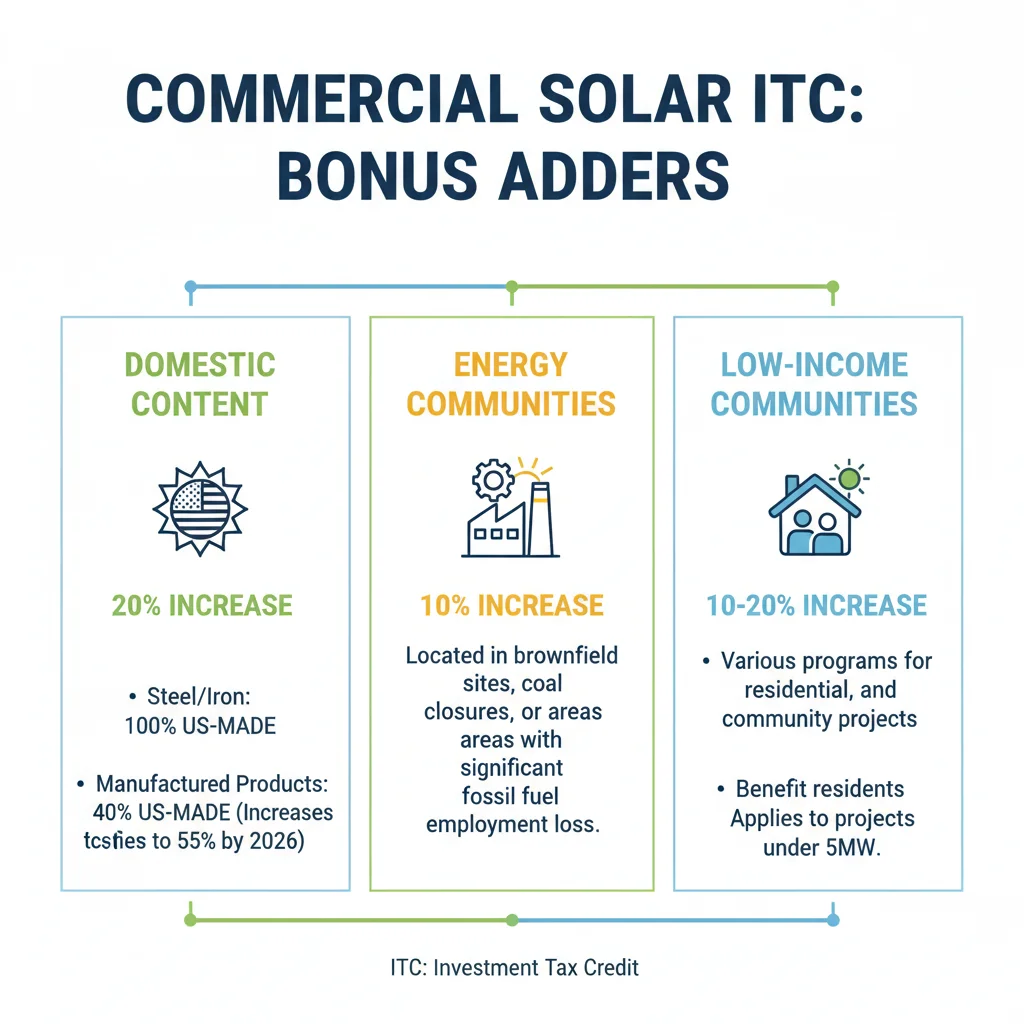
Combining these adders with the base 30% credit means a project could potentially achieve an ITC of 50%. For instance, a project meeting prevailing wage, domestic content, and located in an energy community would qualify for a 30% base + 10% domestic content + 10% energy community = 50% ITC. This level of incentive makes commercial solar incredibly attractive and can dramatically reduce the net cost of installation. Businesses must carefully evaluate their project characteristics and supply chain to determine which bonus adders they are eligible for when planning for the commercial solar ITC 2026.
Direct Pay and Transferability: New Avenues for Accessing the ITC
Historically, the ITC was primarily beneficial for businesses with sufficient tax liability to utilize the credit. However, the Inflation Reduction Act introduced two groundbreaking mechanisms – direct pay and transferability – that significantly broaden the accessibility and utility of the commercial solar ITC 2026 for a wider range of entities.
Direct Pay (Elective Payment)
Direct pay, also known as elective payment, allows certain tax-exempt entities (such as non-profits, state and local governments, and tribal governments) and some for-profit entities (for specific credits, including the ITC) to receive the value of the tax credit as a direct cash payment from the IRS, even if they have no tax liability. This is a game-changer for entities that traditionally couldn’t fully utilize tax credits due to their tax-exempt status or insufficient tax appetite. For tax-exempt entities, direct pay is available for all applicable clean energy credits, including the commercial solar ITC 2026. For for-profit entities, direct pay is generally limited to certain manufacturing credits, but it’s important to monitor IRS guidance for any potential expansions or specific scenarios where it might apply to the ITC.
The direct pay option simplifies the financial structure of solar projects for eligible entities, eliminating the need for complex tax equity partnerships. This can accelerate project development and make clean energy more accessible to a broader range of organizations. Understanding whether your entity qualifies for direct pay is a critical step in financial planning for your commercial solar ITC 2026 project.
Transferability
Transferability allows eligible businesses to sell or transfer their federal tax credits, including the commercial solar ITC 2026, to an unrelated third party for cash. This creates a market for tax credits, enabling businesses with insufficient tax liability to monetize their credits and effectively reduce the cost of their solar projects. The buyer of the tax credit can then use it to offset their own federal tax liability.
This mechanism is particularly beneficial for businesses that are profitable but may not have enough tax liability to fully utilize a large ITC in a single year. Instead of carrying forward the credit for multiple years, they can sell it, receiving immediate cash proceeds that can be reinvested in the project or other business operations. The transferability market is still developing, but it offers a flexible and efficient way for businesses to realize the value of their commercial solar ITC 2026. It’s crucial to work with experienced financial advisors and legal counsel to navigate the complexities of tax credit transfers, ensuring compliance and maximizing the value received.
Both direct pay and transferability represent significant advancements in making clean energy incentives more accessible and liquid, ultimately driving greater investment in commercial solar projects across the country. Businesses should thoroughly explore these options as part of their comprehensive financial strategy for their commercial solar ITC 2026 initiatives.
Strategic Planning for Maximizing Your 2026 Commercial Solar ITC
To fully capitalize on the commercial solar ITC 2026, businesses need to engage in comprehensive strategic planning. This isn’t just about installing solar panels; it’s about optimizing every aspect of the project to leverage all available incentives. Here are key areas to focus on:
Early Engagement and Project Development
Given the specific deadlines for commencing construction and being placed in service to qualify for the current ITC rates, early engagement is crucial. Businesses should start planning their solar projects well in advance of 2025. This includes feasibility studies, site assessments, system design, securing necessary permits, and engaging with qualified solar developers. A proactive approach ensures that your project can meet the critical timelines for the commercial solar ITC 2026.
Due Diligence on Labor Requirements
As discussed, meeting prevailing wage and apprenticeship requirements is essential for the 30% base credit. Businesses must perform thorough due diligence to understand these requirements, integrate them into their project contracts, and ensure compliance throughout the construction phase. Working with developers who have a proven track record of adhering to these labor standards is highly recommended for maximizing your commercial solar ITC 2026.
Identifying and Pursuing Bonus Adders
Evaluate your project’s potential for all three bonus adders: domestic content, energy community, and low-income community. This requires detailed analysis of your supply chain, project location, and potentially applying for the low-income communities bonus credit allocation. Pursuing these adders can significantly increase the overall value of your commercial solar ITC 2026, making the project even more financially attractive.
Financial Modeling and Tax Planning
Develop robust financial models that incorporate the ITC, including potential bonus adders, and account for other financial benefits like accelerated depreciation (MACRS). Consult with tax professionals and financial advisors to understand the implications of the ITC on your specific tax situation, including whether direct pay or transferability is the most advantageous route for your business. Proper tax planning is fundamental to maximizing the real-world benefit of the commercial solar ITC 2026.

Selecting the Right Partners
The success of your commercial solar project and the maximization of your commercial solar ITC 2026 largely depend on the partners you choose. Select experienced solar developers, installers, and legal/tax advisors who are intimately familiar with the ITC rules, bonus adders, and the latest IRS guidance. A knowledgeable team can help navigate complexities, ensure compliance, and optimize your project for maximum financial benefit.
Long-Term Operations and Maintenance
While not directly related to the ITC calculation, ensuring the long-term performance of your solar system is crucial for realizing the full financial benefits over its lifespan. A well-maintained system will generate consistent electricity savings and contribute positively to your business’s sustainability goals. Consider robust operations and maintenance (O&M) contracts as part of your overall project planning to protect your investment and ensure continued eligibility for any future incentives. The long-term efficiency of your system directly impacts the value derived from your initial commercial solar ITC 2026.
Looking Beyond 2026: The Future of Clean Energy Tax Credits
While the focus of this deep dive is the commercial solar ITC 2026, it’s important for businesses to be aware of the broader trajectory of clean energy incentives. For projects that begin construction after December 31, 2024, the ITC transitions into a technology-neutral clean electricity investment tax credit. This new credit will apply to any zero-emission electricity generation facility or energy storage technology, reflecting a broader policy goal of decarbonizing the electricity sector.
The new technology-neutral credit will largely retain the prevailing wage and apprenticeship requirements to qualify for the full 30% rate, and the bonus adders for domestic content and energy communities will also continue. However, the low-income communities bonus credit will also transition to a new program. The key difference is the shift from technology-specific incentives to a more agnostic approach, encouraging innovation across all clean electricity generation methods.
This transition means that while businesses should act now to secure the benefits of the current commercial solar ITC 2026, they also need to stay informed about the evolving landscape of clean energy policy. The fundamental goal remains the same: to provide robust financial incentives for businesses to invest in clean, sustainable energy solutions. Continuous monitoring of Treasury and IRS guidance will be essential for businesses planning long-term clean energy strategies.
Conclusion: Seizing the Commercial Solar ITC Opportunity
The commercial solar ITC 2026 presents an unparalleled opportunity for businesses to invest in solar energy with significant financial backing from the federal government. With a base credit of 30% and the potential for additional bonus adders bringing the total to 50%, the economics of commercial solar have never been more compelling. The introduction of direct pay and transferability further broadens access to these benefits, making solar a viable and attractive option for a diverse array of businesses.
However, realizing the full potential of this tax credit requires meticulous planning, a deep understanding of the eligibility criteria, and strategic navigation of the bonus adders and new monetization mechanisms. Businesses must be proactive in their project development, ensure compliance with prevailing wage and apprenticeship requirements, and engage with experienced professionals to optimize their investment.
As the deadline for projects to qualify under the current ITC structure approaches, the time to act is now. By strategically leveraging the commercial solar ITC 2026, businesses can not only significantly reduce their operational costs and enhance their sustainability profile but also contribute to a cleaner, more resilient energy future. Don’t let this opportunity pass by; begin your journey towards energy independence and substantial financial savings today.