
Navigating the 2026 Commercial Solar ITC: A 30% Tax Credit Deep Dive for U.S. Businesses
In the dynamic landscape of energy policy and sustainable business practices, the Investment Tax Credit (ITC) for solar energy stands out as a powerful incentive for U.S. businesses. Specifically, the commercial solar ITC, bolstered by recent legislation, offers an unprecedented opportunity for companies to significantly reduce their operational costs, enhance their environmental stewardship, and invest in a more sustainable future. As we approach 2026, understanding the nuances of this 30% tax credit becomes paramount for any forward-thinking business.
The Inflation Reduction Act (IRA) of 2022 fundamentally reshaped the clean energy tax landscape, extending and enhancing the solar ITC. For commercial entities, this means a sustained 30% base credit for solar projects that begin construction before 2033, provided certain labor and domestic content requirements are met. This isn’t just a fleeting opportunity; it’s a long-term commitment from the U.S. government to accelerate the transition to renewable energy, making solar power more financially attractive than ever before.
This comprehensive guide will delve deep into the intricacies of the 2026 commercial solar ITC, exploring its eligibility criteria, the significant bonus adders that can elevate the credit even further, and the strategic considerations businesses must undertake to maximize their benefits. Whether you’re a small business owner contemplating your first solar installation or a large corporation looking to expand your renewable energy portfolio, understanding this tax credit is crucial for unlocking substantial financial advantages and contributing to a greener economy.
The Foundation: Understanding the 30% Commercial Solar ITC Base Credit
At its core, the commercial solar ITC provides a tax credit equal to a percentage of the eligible costs of a solar energy system. For projects that commence construction between 2022 and 2032, the base credit is set at a robust 30%. This means that if your business invests $1 million in an eligible solar installation, you could be looking at a $300,000 reduction in your federal tax liability. This isn’t a deduction; it’s a dollar-for-dollar reduction, making it an incredibly powerful financial tool.
To qualify for the full 30% base rate, projects must meet specific prevailing wage and apprenticeship requirements. These requirements, introduced by the IRA, ensure that clean energy jobs are good-paying jobs and that a skilled workforce is developed to support the burgeoning renewable energy sector. Failure to meet these requirements can result in a reduction of the credit to 6%, underscoring the importance of meticulous planning and compliance.
What Constitutes an Eligible Solar Energy System?
The commercial solar ITC applies to a broad range of solar energy property. This typically includes:
- Equipment that uses solar energy to generate electricity for residential or commercial use (e.g., photovoltaic (PV) panels).
- Equipment that uses solar energy to heat or cool (or provide hot water for use in) a structure (e.g., solar water heaters, but generally not for heating swimming pools or hot tubs).
- Fiber-optic distributed sunlight, which uses solar energy to illuminate the inside of a structure.
- Equipment that uses solar energy to provide solar process heat.
- Battery storage technology, when installed in conjunction with a solar energy system, with a capacity of at least 5 kWh. This is a significant addition, allowing businesses to maximize energy independence and resilience.
It’s crucial for businesses to consult with tax professionals and reputable solar developers to ensure their proposed system meets all the necessary criteria for the commercial solar ITC.
Beyond 30%: Unlocking Bonus Adders for the Commercial Solar ITC
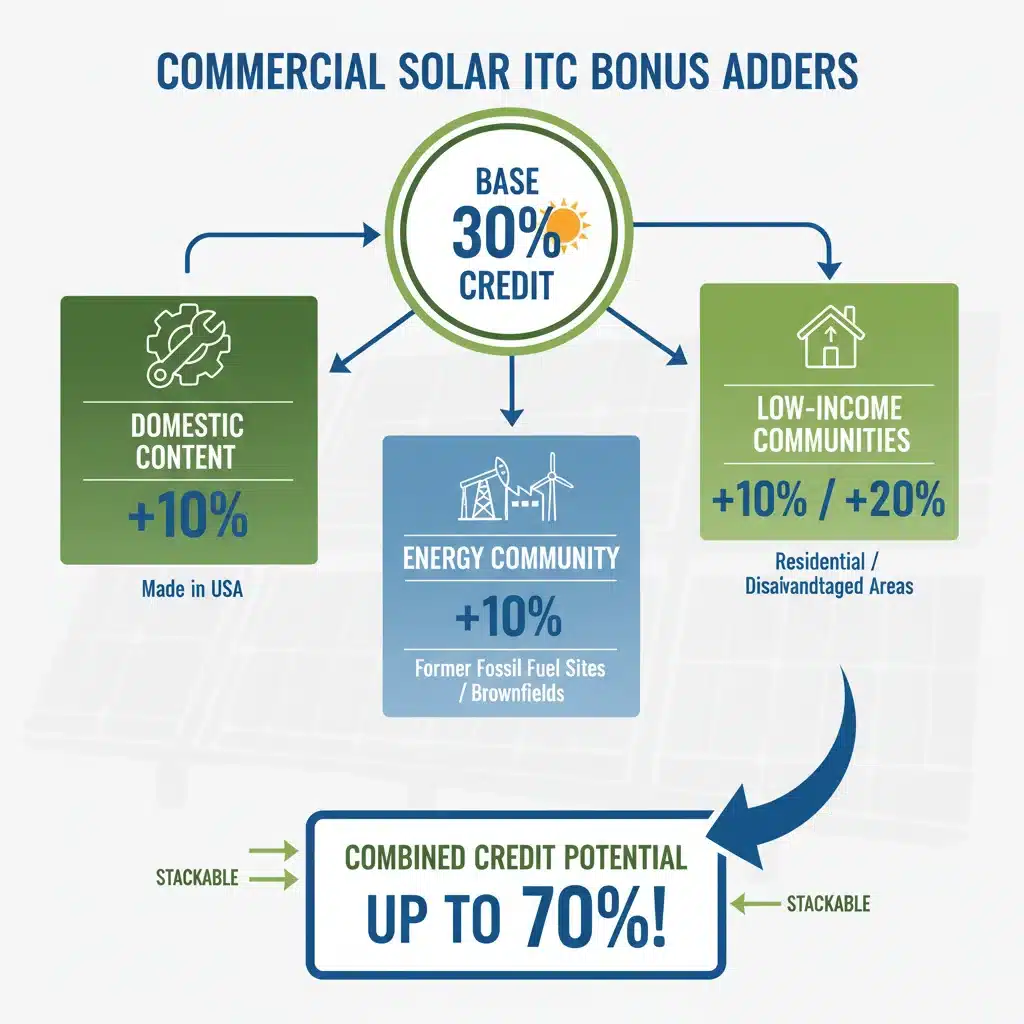
The IRA didn’t just extend the commercial solar ITC; it supercharged it with additional ‘bonus adders’ that can significantly increase the total tax credit. These adders are designed to incentivize specific policy goals, such as supporting domestic manufacturing, investing in economically disadvantaged communities, and promoting equitable energy transitions. Understanding these bonus adders is key to maximizing your financial return on investment.
The Domestic Content Adder: Boosting U.S. Manufacturing
One of the most impactful bonus adders is the domestic content bonus, which can increase the base 30% ITC by an additional 10 percentage points, bringing the total to 40%. To qualify, a certain percentage of the project’s components must be manufactured in the United States. Specifically:
- All manufactured iron or steel components must be produced in the U.S.
- A specified minimum percentage of the total cost of manufactured products (other than iron or steel components) must be attributable to products manufactured in the U.S. This percentage starts at 40% for projects beginning construction before 2025 and gradually increases to 55% for projects beginning construction in 2027 or later.
This adder encourages businesses to source their solar equipment from American manufacturers, supporting domestic job creation and supply chain resilience. For businesses prioritizing sustainability and local economic impact, this bonus makes the commercial solar ITC even more attractive.
The Energy Community Adder: Investing in Transitioning Regions
Another powerful bonus adder, also worth an additional 10 percentage points (potentially bringing the total to 40%), targets investments in ‘energy communities.’ These are defined as areas that have historically relied on fossil fuel production or manufacturing and are now undergoing an economic transition. Examples include:
- Brownfield sites.
- Areas with significant employment or tax revenues from the extraction, processing, transport, or storage of coal, oil, or natural gas, or the generation of electricity from coal or natural gas, and with a certain unemployment rate.
- Census tracts where a coal mine closed after 1999 or a coal-fired power plant retired after 2009.
By investing in solar projects within these designated energy communities, businesses not only benefit from an enhanced commercial solar ITC but also contribute directly to economic revitalization and job creation in areas that need it most. This aligns financial incentives with social and environmental goals, making it a win-win for businesses and communities alike.
Low-Income Communities Bonus Credit Program: Promoting Energy Equity
The IRA also introduced a separate Low-Income Communities Bonus Credit Program, which can provide an additional 10% or 20% credit for eligible solar projects located in low-income communities or on Native American land, or that are part of a qualified low-income residential building project or economic benefit project. This program is highly competitive and allocated annually by the Treasury Department and IRS.
- 10% additional credit: For projects located in a low-income community or on Native American land.
- 20% additional credit: For projects that are part of a qualified low-income residential building project or a qualified low-income economic benefit project.
This program aims to ensure that the benefits of clean energy reach all communities, particularly those that have historically been underserved. While subject to annual allocation, securing this bonus can significantly boost the financial viability of solar projects in these areas, making the commercial solar ITC a tool for energy equity.
Strategic Considerations for Maximizing Your Commercial Solar ITC
Successfully leveraging the commercial solar ITC requires more than just understanding the percentages; it demands strategic planning, meticulous documentation, and expert guidance. Here are key considerations for businesses looking to maximize their solar investment.
Timing is Everything: ‘Begin Construction’ Rules
The eligibility for the 30% base credit (and potentially higher rates in later years) is tied to when a project ‘begins construction.’ The IRS provides specific guidance on what constitutes ‘beginning construction,’ typically involving either:
- Physical Work Test: Significant physical work of a significant nature has begun on the project.
- Five Percent Safe Harbor: At least 5% of the total cost of the facility has been incurred.
It’s crucial to document these start dates meticulously, as they determine the applicable credit rate. While the 30% rate is stable through 2032, understanding these rules is vital for future planning and ensuring compliance.
Navigating Prevailing Wage and Apprenticeship Requirements
As mentioned, meeting prevailing wage and apprenticeship requirements is essential for securing the full 30% commercial solar ITC. Businesses must ensure that all laborers and mechanics employed on the project (including contractors and subcontractors) are paid wages no less than the prevailing wages determined by the Department of Labor for similar work in the locality. Additionally, a certain percentage of total labor hours must be performed by qualified apprentices from registered apprenticeship programs.
These requirements necessitate careful contract negotiation, robust record-keeping, and proactive engagement with labor organizations to ensure compliance. While they add a layer of complexity, the financial benefits of the full 30% credit far outweigh the administrative effort.
Understanding Direct Pay and Transferability
The IRA introduced two revolutionary mechanisms that significantly enhance the usability of the commercial solar ITC: direct pay and transferability.
- Direct Pay: For tax-exempt entities (e.g., non-profits, municipalities, tribal governments) and certain other entities, direct pay allows them to receive the value of the tax credit as a direct cash payment from the IRS, even if they have no tax liability. This dramatically expands access to solar incentives for organizations that previously couldn’t utilize tax credits.
- Transferability: For taxable entities, transferability allows them to sell their eligible clean energy tax credits (including the commercial solar ITC) to unrelated third parties for cash. This provides a mechanism for businesses with insufficient tax appetite to monetize the credit, effectively turning a tax incentive into upfront capital. This is a game-changer for project financing.
These provisions make the commercial solar ITC accessible and valuable to a much wider array of businesses and organizations, removing historical barriers to renewable energy adoption.
The Role of Depreciation: Accelerated Cost Recovery
In addition to the commercial solar ITC, businesses can also benefit from accelerated depreciation (Modified Accelerated Cost Recovery System – MACRS) for solar energy property. This allows companies to recover the cost of their solar assets over a shorter period than their actual useful life, typically five years. Furthermore, bonus depreciation, which allows businesses to deduct a significant portion of the asset’s cost in the first year, can be combined with MACRS to further enhance the financial returns of a solar investment.
Combining the 30% commercial solar ITC with accelerated depreciation can lead to substantial financial benefits, significantly reducing the payback period for solar installations and improving overall project economics. A thorough financial analysis, considering both the ITC and depreciation, is essential for accurate return-on-investment calculations.

Case Study: A Hypothetical Commercial Solar ITC Scenario
To illustrate the power of the commercial solar ITC, let’s consider a hypothetical scenario for a manufacturing business, ‘GreenTech Innovations,’ planning a large-scale rooftop solar installation.
- Project Cost: $2,500,000
- Location: An identified ‘energy community’ with high unemployment.
- Domestic Content: GreenTech commits to sourcing 45% of its manufactured products from U.S. suppliers (meeting the 2024-2025 requirement).
- Labor: GreenTech ensures full compliance with prevailing wage and apprenticeship requirements.
Calculating the ITC Benefits:
- Base ITC: 30% of $2,500,000 = $750,000
- Domestic Content Adder: 10% of $2,500,000 = $250,000
- Energy Community Adder: 10% of $2,500,000 = $250,000
Total Commercial Solar ITC: $750,000 + $250,000 + $250,000 = $1,250,000
In this scenario, GreenTech Innovations could receive a staggering $1.25 million in federal tax credits, representing 50% of their total project cost. This significant reduction in capital outlay dramatically improves the project’s financial viability, leading to a much faster payback period and higher long-term savings on electricity bills. When combined with accelerated depreciation, the financial incentives become even more compelling.
This example highlights how strategic planning around the bonus adders can transform a significant capital expenditure into an exceptionally attractive investment, driven by the enhanced commercial solar ITC.
The Environmental and Social Impact of Commercial Solar Adoption
Beyond the undeniable financial benefits, investing in solar energy through the commercial solar ITC offers profound environmental and social advantages. By transitioning to solar, businesses significantly reduce their carbon footprint, mitigating their contribution to climate change. This not only aligns with global sustainability goals but also resonates positively with increasingly environmentally conscious consumers and stakeholders.
Furthermore, the focus on domestic content and energy communities within the ITC framework ensures that the growth of the solar industry directly supports American manufacturing and revitalizes economically challenged regions. This creates green jobs, fosters innovation, and builds a more resilient and equitable energy infrastructure.
Businesses that embrace solar power demonstrate leadership in corporate social responsibility, enhancing their brand reputation and attracting talent committed to sustainable practices. The commercial solar ITC thus serves as a catalyst for a holistic approach to business development, where financial success and positive societal impact go hand in hand.
Preparing for Your Commercial Solar Investment in 2026 and Beyond
As 2026 approaches, businesses considering solar investments should begin their due diligence now. The complexity of the commercial solar ITC, especially with the various bonus adders and compliance requirements, necessitates a well-thought-out strategy. Here are actionable steps:
- Consult with Experts: Engage with reputable solar developers, tax advisors, and financial consultants who specialize in clean energy projects. Their expertise will be invaluable in navigating the ITC rules, optimizing project design, and ensuring compliance.
- Assess Your Energy Needs: Conduct a thorough energy audit to understand your current consumption patterns and identify the optimal size and configuration for your solar system.
- Evaluate Location and Domestic Content: Determine if your project location qualifies for an energy community adder and explore options for sourcing domestically manufactured components to unlock the domestic content bonus.
- Plan for Labor Compliance: Understand and integrate prevailing wage and apprenticeship requirements into your project planning and contractor agreements from the outset.
- Financial Modeling: Develop detailed financial models that incorporate the commercial solar ITC, bonus adders, depreciation benefits, and potential energy savings to project your return on investment accurately.
- Stay Informed: The clean energy policy landscape can evolve. Stay abreast of any new guidance or regulations issued by the IRS or Department of Treasury regarding the ITC.
The commercial solar ITC represents a generational opportunity for U.S. businesses to invest in clean energy with significant financial backing from the federal government. By understanding its provisions and planning strategically, companies can achieve substantial savings, contribute to environmental sustainability, and position themselves for long-term success in a rapidly evolving energy market.
Conclusion: Seizing the Opportunity with the 2026 Commercial Solar ITC
The 2026 commercial solar ITC, with its robust 30% base credit and powerful bonus adders, stands as a cornerstone of U.S. clean energy policy. It offers an unparalleled incentive for businesses across all sectors to embrace solar power, transforming their energy consumption, reducing operational costs, and enhancing their environmental credentials.
The Inflation Reduction Act has created a stable and attractive framework for solar investment, providing clarity and long-term certainty for businesses. However, realizing the full potential of these incentives requires careful planning, adherence to specific requirements (such as prevailing wage and domestic content), and a proactive approach to project development.
For any U.S. business looking to strengthen its financial position, achieve sustainability goals, and contribute to a greener future, now is the opportune moment to explore the significant advantages offered by the commercial solar ITC. By partnering with experienced professionals and making informed decisions, businesses can unlock substantial tax savings and build a resilient, renewable energy future.