Commercial Solar Installation Costs 2026: Per Watt Breakdown
The dawn of 2026 brings with it renewed optimism and strategic opportunities for businesses looking to embrace sustainable energy solutions. Among the most impactful decisions a commercial entity can make is investing in solar power. However, understanding the intricacies of commercial solar costs, particularly the per-watt breakdown, is paramount for informed decision-making and maximizing return on investment. This comprehensive guide aims to demystify the financial landscape of commercial solar installations in 2026, providing a detailed analysis of what businesses can expect to pay, what factors influence these costs, and how to navigate the market effectively.
As the global push towards decarbonization accelerates, solar energy continues to emerge as a leading contender for commercial power generation. The technology has matured, efficiency has soared, and, perhaps most importantly for businesses, costs have become increasingly competitive. But what exactly goes into the price tag of a commercial solar system? And how can businesses accurately project their investment in 2026? Let’s delve into the specifics.
Understanding the Per-Watt Cost of Commercial Solar in 2026
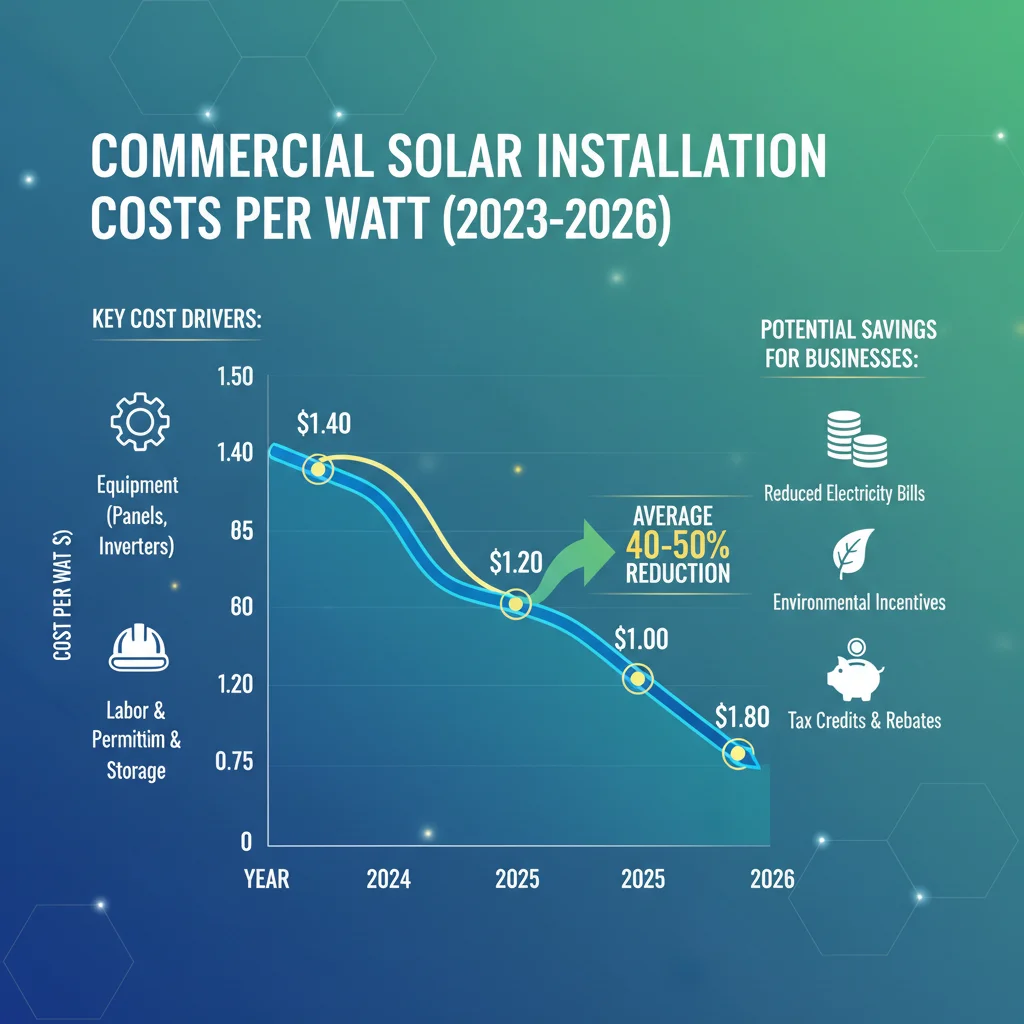
When discussing commercial solar costs, the most common metric used for comparison and estimation is the ‘cost per watt.’ This figure provides a standardized way to evaluate different systems, regardless of their total size. In 2026, the average commercial solar installation cost per watt is projected to range significantly, influenced by a multitude of factors we will explore. However, preliminary analyses suggest a continued downward trend, making solar even more accessible and attractive.
What Does ‘Cost Per Watt’ Encompass?
The ‘cost per watt’ isn’t just the price of the solar panels themselves. It’s an all-encompassing figure that includes:
- Solar Panels (Modules): The photovoltaic cells that convert sunlight into electricity. Prices vary based on efficiency, brand, and warranty.
- Inverters: Devices that convert the DC electricity generated by panels into AC electricity usable by the business and the grid. Options include string inverters, microinverters, and hybrid inverters.
- Racking and Mounting Hardware: The structural components that secure the panels to the roof or ground.
- Balance of System (BOS) Components: This covers all other electrical components, such as wiring, conduits, disconnects, and monitoring systems.
- Labor: The cost of design, engineering, procurement, installation, and project management. This can be a significant portion of the total cost.
- Permitting and Interconnection Fees: Costs associated with obtaining necessary permits from local authorities and connecting to the utility grid.
- Soft Costs: These include customer acquisition, overhead, and other administrative expenses.
By breaking down the commercial solar costs into these components, businesses can gain a clearer understanding of where their investment is going and identify potential areas for optimization. The ongoing technological advancements and increased manufacturing scale continue to drive down the prices of panels and inverters, but soft costs and labor can still represent a substantial portion of the overall expenditure.
Key Factors Influencing Commercial Solar Installation Costs in 2026
While a general per-watt range can be established, the actual price a business pays for its commercial solar system can vary widely. Several critical factors come into play:
1. System Size and Scale
Larger commercial solar installations typically benefit from economies of scale. The per-watt cost tends to decrease as the system size increases, as fixed costs (like permitting and design) are spread over more watts of capacity. A small 10 kW system will likely have a higher per-watt cost than a 100 kW system or a multi-megawatt installation.
2. Panel Efficiency and Technology
High-efficiency panels, while having a higher upfront cost per panel, can sometimes lead to a lower overall per-watt cost if they allow for a smaller footprint or reduce the number of panels needed to achieve the desired output. Monocrystalline panels generally offer higher efficiency than polycrystalline panels, impacting the initial investment.
3. Installation Type (Rooftop vs. Ground-Mount vs. Carport)
The method of installation significantly affects commercial solar costs. Rooftop installations are common and often the most cost-effective, assuming the roof is structurally sound and has adequate space. Ground-mount systems may require more extensive site preparation and racking but offer flexibility in orientation. Solar carports, while providing dual benefits of power generation and shade, typically have the highest per-watt cost due to the complex structural requirements.
4. Location and Local Regulations
Geographic location plays a crucial role. Solar irradiance levels dictate how much energy a system can produce, influencing the required system size. Local labor costs, permitting complexities, and specific building codes can also impact the overall project expense. Regions with strong solar incentives or streamlined permitting processes often see lower effective costs.
5. Equipment Quality and Warranty
Investing in higher-quality components from reputable manufacturers can lead to greater longevity, better performance, and more robust warranties. While this might increase the initial outlay, it often results in lower maintenance costs and higher energy production over the system’s lifespan, ultimately reducing the effective commercial solar costs in the long run.
6. Financing Options and Incentives
The way a project is financed can significantly alter the perceived and actual costs. Cash purchases, solar loans, Power Purchase Agreements (PPAs), and solar leases each have different financial implications. Furthermore, understanding and leveraging available federal, state, and local incentives – such as the Investment Tax Credit (ITC), accelerated depreciation (MACRS), and various grants or rebates – can drastically reduce the net cost of a commercial solar system.
Breaking Down the Per-Watt Cost: What to Expect in 2026
While specific figures will always depend on the factors mentioned above, we can provide a generalized breakdown of commercial solar costs per watt for 2026:
Average Commercial Solar Cost Per Watt (2026 Projections)
- Small Commercial (10 kW – 50 kW): Typically ranges from $2.50 – $3.50 per watt. These systems often have higher per-watt costs due to less significant economies of scale.
- Medium Commercial (50 kW – 250 kW): Expected to fall within $2.00 – $3.00 per watt. This range is common for many businesses, including offices, retail stores, and smaller manufacturing facilities.
- Large Commercial/Industrial (250 kW – 1 MW+): Could see costs between $1.50 – $2.50 per watt. Larger projects benefit significantly from bulk purchasing and more efficient installation processes.
It’s crucial to remember that these are gross costs before any incentives are applied. The net cost after incentives can be substantially lower, making the investment even more attractive.
Component-Specific Cost Breakdown (Estimated Percentages)
- Solar Panels: 25-35% of total cost
- Inverters: 10-15% of total cost
- Racking & Mounting: 8-12% of total cost
- Balance of System (BOS): 10-15% of total cost (wiring, disconnects, monitoring)
- Labor (Design, Engineering, Installation): 15-25% of total cost
- Permitting, Inspection, Interconnection: 3-7% of total cost
- Soft Costs (Customer Acquisition, Overhead): 5-10% of total cost
This breakdown provides a general framework. Actual percentages can fluctuate based on market conditions, supplier relationships, and project complexity. Understanding these proportions helps businesses identify where cost efficiencies can be found.
Maximizing ROI and Reducing Effective Commercial Solar Costs
While the initial outlay for a commercial solar system can seem significant, the long-term benefits, coupled with strategic planning, can lead to substantial returns. Here’s how businesses can optimize their investment and reduce effective commercial solar costs:
1. Leverage All Available Incentives
The federal Investment Tax Credit (ITC) remains a cornerstone incentive, offering a significant tax credit for solar installations. Businesses should also research state and local programs, including property tax exemptions, sales tax exemptions, performance-based incentives (PBIs), and Renewable Energy Certificates (RECs). Consulting with a solar financial expert is highly recommended to ensure all eligible incentives are captured.
2. Optimize System Design
A well-designed system is crucial for maximizing energy production and minimizing costs. This involves careful consideration of roof orientation, shading, panel tilt, and inverter selection. An experienced solar installer will perform a detailed site assessment and energy analysis to design a system that meets the business’s energy needs efficiently and cost-effectively.
3. Consider Energy Storage Solutions
While adding battery storage increases upfront commercial solar costs, it can significantly enhance ROI by allowing businesses to store excess solar energy and use it during peak demand hours or power outages. This can reduce reliance on the grid during expensive periods, provide energy resilience, and potentially enable participation in demand response programs.
4. Explore Financing Options
For businesses that prefer not to make a large upfront capital expenditure, various financing models can make solar accessible:
- Solar Loans: Allow businesses to own the system immediately, benefiting from tax credits and depreciation, while spreading the cost over time.
- Power Purchase Agreements (PPAs): A third-party owner installs and maintains the system, and the business purchases the electricity generated at a fixed, often lower, rate. This eliminates upfront costs.
- Solar Leases: Similar to PPAs, but the business pays a fixed monthly lease payment for the solar system.
5. Focus on Long-Term Savings and Environmental Benefits
Beyond the immediate financial incentives, the true value of commercial solar lies in long-term energy savings and environmental stewardship. Businesses can lock in electricity rates for decades, protecting themselves from rising utility costs. Furthermore, showcasing a commitment to sustainability can enhance brand image, attract environmentally conscious customers, and improve employee morale.
The Future of Commercial Solar: Trends Beyond 2026
The solar industry is dynamic, with continuous innovation driving down costs and improving performance. Beyond 2026, several trends are poised to further shape the landscape of commercial solar costs:
Continued Technological Advancements
Expect to see even more efficient solar panels, advanced inverter technologies, and smarter energy management systems. Perovskite solar cells, for instance, hold promise for higher efficiencies at lower manufacturing costs, potentially revolutionizing panel prices.
Integration with Smart Grids and AI
As grids become smarter, commercial solar systems will increasingly integrate with artificial intelligence to optimize energy generation, consumption, and storage. This intelligent management can lead to even greater cost savings and grid stability.
Increased Focus on Circular Economy
The industry is moving towards more sustainable manufacturing processes and end-of-life recycling for solar panels. While this might have minor cost implications, it ensures the long-term environmental viability of solar energy.
Policy and Regulatory Evolution
Government policies will continue to evolve, potentially introducing new incentives or regulations that could impact commercial solar costs and adoption rates. Staying informed about these changes will be critical for businesses planning future solar investments.
Choosing the Right Commercial Solar Partner
Selecting a reputable and experienced commercial solar installer is perhaps one of the most crucial steps in ensuring a successful project and an optimized investment. Here’s what to look for:
- Experience and Track Record: Choose a company with a proven history of successful commercial installations. Ask for case studies and references.
- Certifications and Licensing: Ensure the installer is properly licensed, insured, and has relevant industry certifications (e.g., NABCEP).
- Comprehensive Services: Look for partners who offer end-to-end services, from initial assessment and design to installation, permitting, and ongoing maintenance.
- Financial Expertise: A good partner will help you navigate incentives, financing options, and provide a clear ROI analysis.
- Warranty and Support: Understand the warranties offered on equipment and workmanship, as well as post-installation support.
A reliable partner will not only provide a competitive per-watt cost but also ensure the system is designed for optimal performance and longevity, ultimately reducing the total cost of ownership and maximizing the benefits of your commercial solar investment.
Conclusion: A Bright Future for Commercial Solar in 2026
Investing in commercial solar in 2026 is not just an environmentally responsible choice; it’s a strategically sound business decision. With continually decreasing commercial solar costs per watt, robust incentives, and advancements in technology, the financial case for solar has never been stronger.
By understanding the components of the per-watt cost, recognizing the factors that influence pricing, and strategically leveraging available resources, businesses can confidently embark on their solar journey. The transition to solar power offers not only significant long-term energy savings and protection against volatile utility prices but also positions businesses as leaders in sustainability, enhancing their brand and contributing to a greener future. The time to evaluate and invest in commercial solar is now, setting your business up for decades of clean, cost-effective energy.