Beyond the Rooftop: Unpacking the Evolving Benefits of Community Solar Projects
For millions of Americans, the dream of solar power has always felt just out of reach, blocked by the practical realities of renting, living in a condo, or owning a home with a shaded roof. High electricity bills arrive like clockwork, yet the most popular solution—rooftop panels—remains an option for a select few. This has created a significant gap in the clean energy transition, leaving a majority of households as passive consumers in a system they have little power to change. But what if you could access the benefits of solar without ever touching your roof?
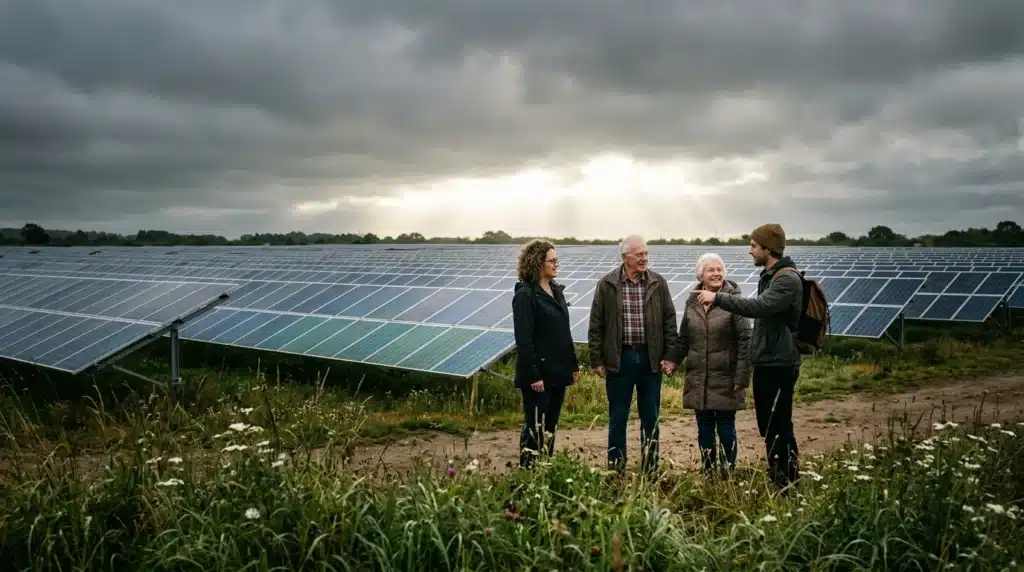
Enter the community solar project, a model that is fundamentally reshaping who gets to participate in renewable energy. Instead of a private home installation, community solar operates like a subscription service. A large, local solar farm is built, and residents can purchase a share of the energy it produces. This simple yet powerful concept decouples solar access from property ownership, opening the door for nearly anyone with an electricity bill to save money and support clean power.
This guide unpacks the evolving benefits that extend far beyond a simple bill credit. We will explore the direct financial savings and incentives that make these programs so attractive, from virtual net metering to new federal support. We’ll also examine the significant local environmental impact, the economic growth through job creation, and the key role community solar plays in advancing energy equity. Finally, we’ll look ahead at emerging trends like battery storage and microgrids that are transforming these projects into cornerstones of a more resilient and democratic energy future.
The Core Value Proposition: Why Community Solar is Gaining Momentum
For a long time, solar power felt exclusive to homeowners with perfect, sunny rooftops. Community solar projects change that script entirely. It functions like a subscription service for clean energy—you simply buy a share in a large, local solar farm and receive credits on your utility bill.
This model provides access to solar for millions of people previously left out. Renters, condo owners, and those with shaded roofs can finally participate. The underrated factor here is choice. Suddenly, people who couldn’t host panels can still vote for clean energy with their wallets and reduce their monthly bills.
The market’s rapid expansion reflects this new accessibility. Data from the Solar Energy Industries Association (SEIA) shows the U.S. community solar market has grown by over 110% in just a few years. It’s a practical path for households to reduce their energy costs, often serving as their first step into solar.
This trend points toward a more inclusive and distributed grid, moving beyond the limitations of individual rooftops.
Financial Upsides: Navigating Savings and Incentives in Current Programs
The most direct benefit of joining a community solar project is the reduction in your monthly electricity bill. Unlike installing your own rooftop system, this approach requires no significant upfront investment or property ownership. You are essentially subscribing to a portion of a large, local solar farm and receiving credits for the energy it produces. This makes solar savings accessible to a much broader audience, including renters and apartment dwellers.
Understanding Bill Credits and Subscription Models
The financial mechanics of community solar hinge on a system called virtual net metering. The solar farm generates electricity, which is fed into the local power grid. Your utility company then applies credits to your bill based on your subscription size and the amount of energy produced. Think of it like getting a discount on your grocery bill for being part of a food co-op—you’re buying into a larger system to get a better rate.
Subscribers typically pay a fee to the community solar developer, which is intentionally set lower than the value of the bill credits received. For example, you might receive a $100 credit on your utility bill but only pay the solar company $88 for that month’s subscription, resulting in a net savings of $12. The data suggests—though it varies by program—that most subscribers see a guaranteed savings of 5% to 15% on their annual electricity costs. It’s a simple, hands-off way to save money.
State-Specific Incentives and Federal Support
While the concept is straightforward, the value proposition is heavily influenced by local and federal policies. States like New York, Massachusetts, and Minnesota have created strong regulatory frameworks that encourage community solar development through grants and tax incentives for project owners. The underrated factor here is how these developer-side benefits translate into better subscription rates for consumers. When developers can build more affordably, they can pass those savings on.
These programs often run alongside other clean energy initiatives, creating a layered system of financial benefits. For companies looking to develop these projects, understanding the local landscape is key, as some of the latest financing innovations for small businesses are tied directly to these state-level programs. This support structure is what makes many community solar projects financially viable in the first place.
The Impact of the Inflation Reduction Act on Community Solar
A significant recent development is the federal support provided through the Inflation Reduction Act (IRA). The act revitalized and expanded the Investment Tax Credit (ITC) for solar projects, but it also introduced specific bonus credits that directly benefit community solar. According to the Department of Energy, projects serving low-income communities or located in designated “energy communities” can receive bonus credits of 10% to 20% on top of the base credit.
This federal backing makes it more profitable for developers to build projects in underserved areas, which in turn expands access to solar savings for households that stand to benefit most from reduced energy costs. It effectively lowers the barrier to entry for both developers and subscribers.
Comparing Savings: Community Solar vs. Rooftop vs. Traditional Grid
When evaluating your options, it’s helpful to compare community solar against the alternatives. Sticking with the traditional grid means paying 100% of your utility’s fluctuating rate with no savings. It is the baseline against which all solar options are measured. What does this mean for your actual wallet?
Installing your own rooftop panels offers the highest potential for long-term savings. After recovering the initial installation cost—which can be substantial—homeowners can offset a large portion, if not all, of their electricity bill. Coupled with the right equipment, you can explore advanced options like solar battery storage for even greater independence. this path is only available to property owners with suitable roofs and the capital (or financing) for the upfront investment.
Community solar offers a middle ground. There’s no installation, no maintenance (a surprisingly common headache for system owners), and no property ownership requirement. While the savings, typically around 12% annually according to a National Renewable Energy Laboratory (NREL) report, are more modest than a fully paid-off rooftop system, they are immediate and risk-free. It’s an excellent first step for anyone interested in solar, and combining it with a DIY home energy audit can further compound your overall utility savings.
As state and federal incentives continue to evolve, the financial calculations for all types of solar will likely shift, potentially making these programs even more attractive.
Community solar fundamentally democratizes clean energy. It shifts the paradigm from ‘do you own a suitable roof?’ to ‘do you pay an electricity bill?’, opening the door for millions of previously excluded households to participate in the energy transition.
— Jeff Cramer, President and CEO of the Coalition for Community Solar Access
| Feature | Community Solar | Rooftop Solar | Traditional Grid |
|---|---|---|---|
| Upfront Cost | $0 | $15,000 – $25,000+ | $0 |
| Typical Savings | 5% – 15% annually | 50% – 100% (after payback period) | 0% (subject to rate hikes) |
| Maintenance | None (handled by developer) | Owner is responsible | None |
| Eligibility | Most utility customers (including renters) | Property owners with suitable roofs | All utility customers |
Environmental Impact: Driving Local Sustainability and Decarbonization
Beyond the direct financial perks for subscribers, community solar projects are powerful engines for local environmental change. They provide a vital pathway for renters, condo owners, and those with unsuitable roofs to access renewable energy, directly reducing a community’s reliance on fossil fuels. This collective approach accelerates the transition to clean power in a way individual rooftop installations alone cannot.
The numbers are significant. A typical 5-megawatt community solar farm can displace over 3,700 metric tons of carbon dioxide annually, according to data from the National Renewable Energy Laboratory (NREL). How much is that, really? It’s equivalent to taking nearly 800 gasoline-powered cars off the road for a year. This aggregation of clean energy generation is like pooling resources for a much larger impact than any single household could achieve on its own.
This localized power generation directly reduces stress on the traditional grid.
What many people miss is that these projects also promote land use efficiency, often being built on underutilized land like brownfields or near industrial parks. By centralizing solar production, communities can achieve greater solar panel efficiency and power output without covering every available rooftop. It encourages a broader mindset shift, prompting more people to consider their own consumption through actions like a DIY home energy audit. These projects are a tangible step toward greater community-wide energy independence and a cleaner local environment.
Social and Economic Catalysts: Strengthening Local Communities
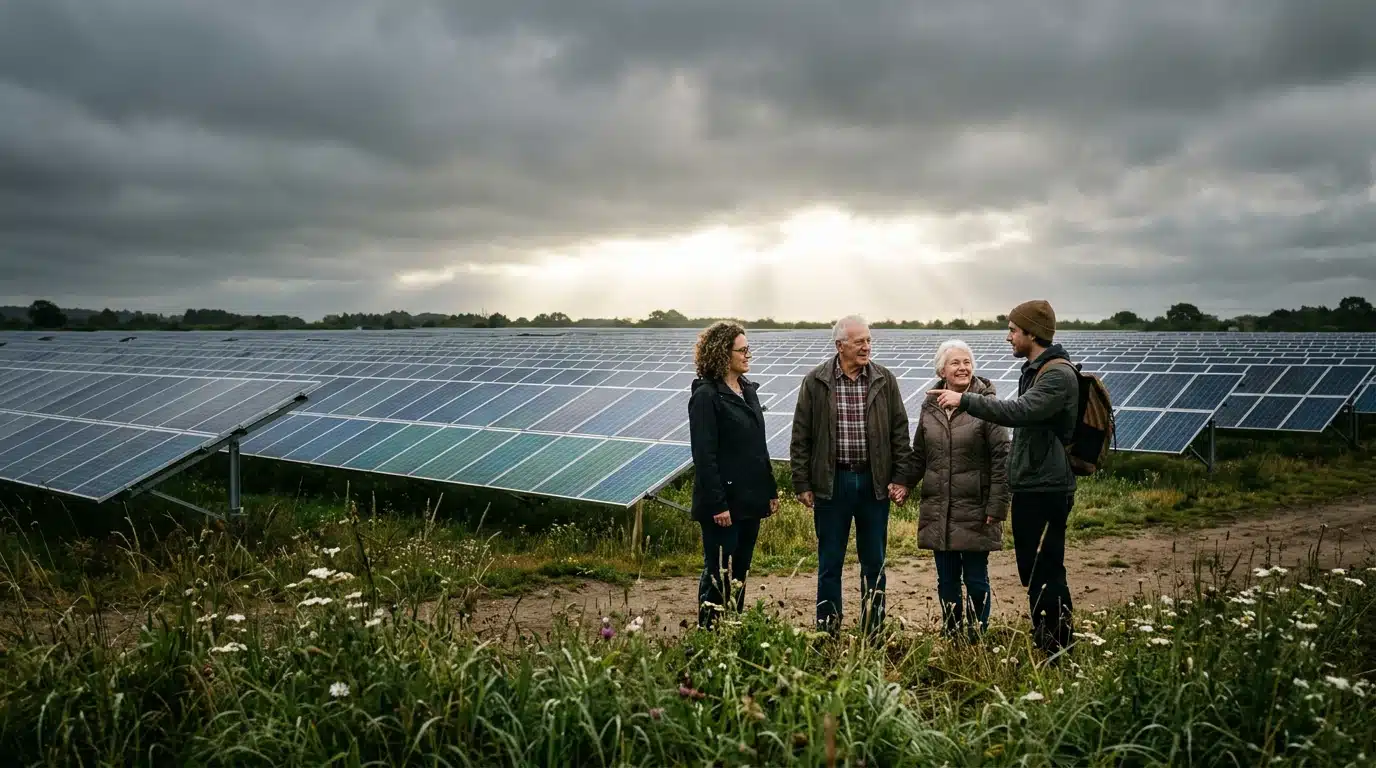
While the environmental perks of community solar are clear, the benefits ripple much further, acting as a powerful engine for local economies and social cohesion. These projects are more than just power generators. They are community builders creating tangible value that stays right where it’s needed most.
Fostering Local Employment and Economic Growth
One of the most immediate impacts of a new community solar project is job creation. These aren’t just temporary construction gigs. According to the National Renewable Energy Laboratory (NREL), each megawatt of community solar installed can support around 2.7 long-term jobs in operations and maintenance. For a typical 5-megawatt project, this translates to over a dozen stable, local positions for electricians, landscapers, and administrative staff.
The economic effect multiplies beyond direct hiring. Local contractors are often used for site preparation, and nearby businesses see increased traffic from workers. It’s like choosing a local farmer’s market over a national grocery chain—the money circulates within the community, supporting other ventures. This local investment cycle is a key reason why many municipalities are exploring new financing models for solar to keep that economic activity close to home.
Addressing Energy Equity and Access
Perhaps the most significant social benefit is the push for energy equity. For decades, solar was primarily accessible to homeowners with good credit and sunny rooftops. Community solar flips that script. It provides a pathway for renters, apartment dwellers, and low-to-moderate-income (LMI) households to access clean energy and see real savings—often 10-20% off their monthly electricity bills without any upfront investment.
This isn’t just theoretical. Consider the work of organizations like Cooperative Energy Futures in Minnesota, which has successfully developed multiple solar gardens with a specific focus on ensuring at least 51% of subscribers are LMI families. But does simply providing access solve the whole problem? The underrated factor here is the stability these savings provide, allowing families to better manage their budgets against volatile utility prices.
These projects also build local resilience. By generating power locally, communities become less dependent on a distant, centralized grid that can be vulnerable to widespread outages. This distributed generation model creates a more stable energy future for everyone involved. Understanding your own consumption by performing a DIY home energy audit is a great first step to seeing how much you could save with a community solar subscription, a key part of many strategies for energy independence.
Emerging Trends: What’s Next for Community Solar Benefits
The core promise of community solar has always been access to clean energy without rooftop panels. But the next wave of community solar project benefits is moving far beyond simple electricity bill credits. Developers are now integrating new technologies and business models that actively strengthen our energy infrastructure while providing more value to subscribers. The field is evolving rapidly.
The Rise of Community Solar-Plus-Storage
One of the most significant shifts is the addition of battery storage to community solar farms. Think of it like a community food bank for electricity. Instead of just using the solar energy as it’s produced, these systems store excess power generated during sunny afternoons for later use. This stored energy can be dispatched during evening peak hours or on cloudy days, ensuring a more consistent and reliable power supply.
This isn’t just a niche concept; it’s becoming the standard. According to the National Renewable Energy Laboratory (NREL), nearly a third of all new community solar projects in development now include a storage component. For subscribers, this can mean access to more stable energy prices and, in some markets, additional credits for helping the grid. A deeper look into the costs and future value of solar battery storage shows why this trend has so much momentum.
Enhancing Grid Stability and Resilience
Pairing solar with storage does more than just time-shift energy for subscribers. It transforms a community solar project into a valuable asset for the local utility and the entire grid. These distributed energy resources can help balance supply and demand, reducing the strain on traditional power plants and transmission lines. This is a big deal.
During extreme weather events or heatwaves when the grid is under immense stress, utilities can draw power from these community solar-plus-storage sites. This provides what’s known as “grid services,” helping to prevent brownouts or blackouts. Essentially, your subscription isn’t just lowering your bill; it’s actively contributing to a more reliable power system for everyone in your area.
Microgrids and Energy Independence
Taking resilience a step further, some next-generation community solar projects are designed to function as the heart of a local microgrid. A microgrid is a self-sufficient energy system that can disconnect from the main grid and operate independently during a power outage. What does that mean in practice? A community solar project connected to a microgrid could keep critical facilities—like hospitals, fire stations, or emergency shelters—powered during a widespread blackout.
This creates pockets of energy security and is a key part of building true grid resilience solar. For residents and businesses, this offers an extraordinary level of reliability that the traditional grid often cannot guarantee. It’s a tangible step toward achieving local strategies for energy independence.
Innovative Program Designs and Subscriber Engagement
The technology isn’t the only thing evolving; the subscription models are getting smarter, too. Project developers are moving beyond one-size-fits-all plans to attract a wider range of participants. We’re seeing more flexible contract lengths, subscription tiers based on energy usage, and even partnerships with electric vehicle (EV) charging networks to offer bundled benefits.
Some programs are experimenting with time-of-use (TOU) credits, which provide greater savings to subscribers who can shift their heavy energy consumption to off-peak hours. This gamifies energy saving and encourages more efficient behavior. For small businesses, new financing structures are making participation more accessible than ever, sometimes mirroring the latest financing innovations for rooftop solar.
When evaluating a modern community solar project, look beyond the basic cost-per-kilowatt-hour. Consider these forward-thinking features:
- Integrated Battery Storage: Does the project include a storage component for enhanced reliability and potential for additional savings?
- Resilience Benefits: Is the project tied to a microgrid or designated to provide backup power for critical community facilities?
- Flexible Subscription Terms: Are there options for shorter contracts or the ability to easily transfer your subscription if you move?
- Advanced Credit Structures: Does the program offer benefits beyond a simple bill credit, such as TOU rates or rewards for energy efficiency?
- Transparent Performance Data: Does the provider offer a portal or app to track your share of the solar farm’s energy production in real-time?
These community solar innovations are reshaping the landscape, turning what was once a simple financial arrangement into a more dynamic partnership between subscribers, developers, and the grid itself.
Navigating Participation: A Step-by-Step Guide to Joining a Project
The path to subscribing to a community solar project is more accessible than ever, but it requires a bit of homework. With the number of active projects growing by over 70% in some regions, according to data from the National Renewable Energy Laboratory (NREL), potential subscribers have a wealth of options. The key is to find a project that aligns with your financial goals and values.
This isn’t a one-size-fits-all decision.
Finding Available Projects in Your Area
Your search should start at the state level. Many state energy departments or public utility commissions maintain databases of registered community solar providers. These official lists are a great starting point for finding legitimate operations in your utility’s service territory. independent marketplaces have emerged that allow you to compare multiple offers side-by-side, much like shopping for insurance.
But don’t overlook local initiatives. Some of the most impactful projects are run by local cooperatives or non-profits, which may not appear on larger commercial databases. A quick search for projects in your specific county or town can uncover hidden gems with strong community ties and transparent management. These smaller projects often offer more direct engagement and a clearer line of sight into where your money is going.
Key Considerations Before Enrollment
Choosing a community solar subscription is a bit like picking a cell phone plan; the headline offer looks great, but the details in the contract determine the real value. Before you sign any agreement, it’s required to get clear answers to several questions. The underrated factor here is understanding exactly how you will be billed and credited. Asking the right questions upfront can prevent major headaches later.
Here are the critical points to clarify with any potential provider:
- What is the subscription agreement type? Ask if you are purchasing a share, leasing panels, or entering into a Power Purchase Agreement (PPA). Each model has different implications for ownership and payment structure, similar to the options available in new financing models for businesses.
- How are savings calculated and guaranteed? Providers should be able to clearly explain the credit rate you’ll receive on your utility bill and compare it to your subscription fee. Are the savings a fixed percentage, or do they fluctuate with the energy market?
- What are the cancellation policies and fees? Life happens. You need to know the penalty—if any—for terminating your contract early. Some modern providers offer penalty-free cancellation with 60-90 days’ notice.
- What is the process if I move? Portability is a major benefit of community solar. Confirm that you can take your subscription with you if you move within the same utility territory or easily transfer it to a new subscriber.
Reading the full disclosure form and contract is non-negotiable. This document outlines every detail of your subscription and is your best tool for avoiding common solar project pitfalls. By entering this process with clear eyes and a list of questions, you’re not just buying clean energy; you’re making a savvy financial decision that contributes to greater strategies for energy independence.
Beyond Savings: Your Stake in a Resilient Energy Future
The conversation around community solar is shifting. While the immediate 5-15% savings on a utility bill is a compelling entry point, it’s merely the first layer of a much deeper transformation. These projects are evolving from simple financial instruments into active, vital components of our local energy infrastructure. By integrating battery storage and forming the backbone of microgrids, community solar is building a more distributed, resilient, and equitable power system from the ground up.
This transition reframes your role from that of a passive ratepayer to an active stakeholder in your community’s energy security. Your subscription does more than lower your costs; it helps stabilize the grid for your neighbors, supports local jobs, and ensures critical facilities can stay powered during an emergency. As you consider your options, the question is no longer just about saving money. The more important question now is: how will your participation help build a cleaner and more reliable energy future for your entire community?
Frequently Asked Questions About Community Solar
What is a community solar project and how does it work?
A community solar project is a large, centralized solar farm that local residents can subscribe to. Instead of installing panels on your own property, you buy a share of the energy produced by the project and receive credits on your regular utility bill, which lowers your monthly costs.
Who can participate in a community solar project?
Participation is open to most utility customers within a specific service area, making it an ideal solution for a wide range of people. This includes renters, apartment and condo dwellers, and homeowners whose properties are not suitable for rooftop panels due to shading, orientation, or structural issues.
What are the typical financial savings from joining community solar?
Subscribers typically save between 5% and 15% on their annual electricity costs. The savings come from the bill credits you receive from the utility, which are valued higher than the monthly subscription fee you pay to the community solar provider. There is usually no upfront cost to join.
Are there any risks associated with community solar subscriptions?
Community solar is a very low-risk option. Since you don’t own the equipment, you are not responsible for any maintenance or repairs. The primary consideration is the subscription agreement, so it’s important to review the contract length and any potential early cancellation fees before signing up.
How does community solar contribute to local clean energy goals?
Community solar projects directly increase the amount of renewable energy on the local grid, reducing the community’s dependence on fossil fuel power plants. By making solar accessible to a broader population, including renters and low-income households, it accelerates the transition to clean energy and promotes greater energy equity.