Unlocking Solar Potential: Expert Strategies for Commercial & Residential Energy Independence
Making the switch to solar power feels like a straightforward decision for energy independence and sustainability. Yet, many property owners unknowingly walk into a financial trap, treating a complex engineering project like a simple appliance purchase. The reality is that the difference between a solar array that becomes a high-performing financial asset and one that becomes a 25-year-long headache lies in the details—details that off-the-shelf solutions and cut-rate installers almost always miss.
The solar landscape is littered with complexities far beyond simply choosing panels. It involves navigating a maze of local permitting laws, intricate utility agreements, and specific tax codes that can make or break the project’s return on investment. A system’s long-term value isn’t determined by the hardware alone, but by a strategic design that considers granular shade analysis, your property’s unique energy consumption profile, and future needs like electric vehicle charging. Without expert guidance, property owners risk installing systems that can underproduce by over 30%, negating the very savings they sought to achieve.
Is there a way to guarantee you’re on the right side of that equation? This guide moves beyond the beginner’s overview to provide expert-level strategies for both commercial and residential solar projects. We will dissect the professional pathways to grid independence for businesses, explore the blueprints for sustainable home power, and reveal why integrating energy efficiency is the non-negotiable first step that professionals insist upon. Prepare to learn how to transform your property into a meticulously planned power plant, not just another house with panels on the roof.
Beyond the Basics: Why Expert Guidance Matters for Solar Investments
Thinking a solar installation is just a grown-up LEGO project is a costly mistake. While the idea of harnessing the sun seems straightforward, the reality of a successful solar investment is layered with technical, regulatory, and financial complexities that can easily overwhelm an unprepared property owner. This isn’t just about bolting panels to a roof; it’s about engineering a power plant scaled to your specific needs. It’s a serious financial decision.
From navigating Byzantine local permitting laws and utility interconnection agreements to calculating the precise tilt and azimuth for maximum energy harvest, the variables are immense. What most people miss is that a system’s long-term ROI for solar isn’t guaranteed by the hardware alone. A report from the National Renewable Energy Laboratory (NREL) suggests that improperly sited or installed systems can underproduce by as much as 31% over their lifespan, completely wrecking financial projections.
Dr. Chloe Vance, an independent energy systems analyst, puts it bluntly. “The DIY and ‘cut-rate consultant’ approach is the most expensive path in the long run. I’ve seen homeowners lose thousands in unclaimed tax credits and commercial clients install systems that fail structural inspections. Is saving a few hundred dollars upfront worth a 25-year headache?” This is why moving beyond a basic solar for beginners mindset is so critical for a successful project.
Ultimately, a professional consultation acts as your project’s architect, ensuring every component—from the panel choice to the inverter technology—works together. This expertise is what separates a high-performing asset from a depreciating gadget. Getting it right means integrating solar for a sustainable lifestyle, not just participating in it. The goal is to build an energy solution that performs optimally on day one and continues to deliver value for decades.
Commercial Solar Success: Professional Pathways to Grid Independence
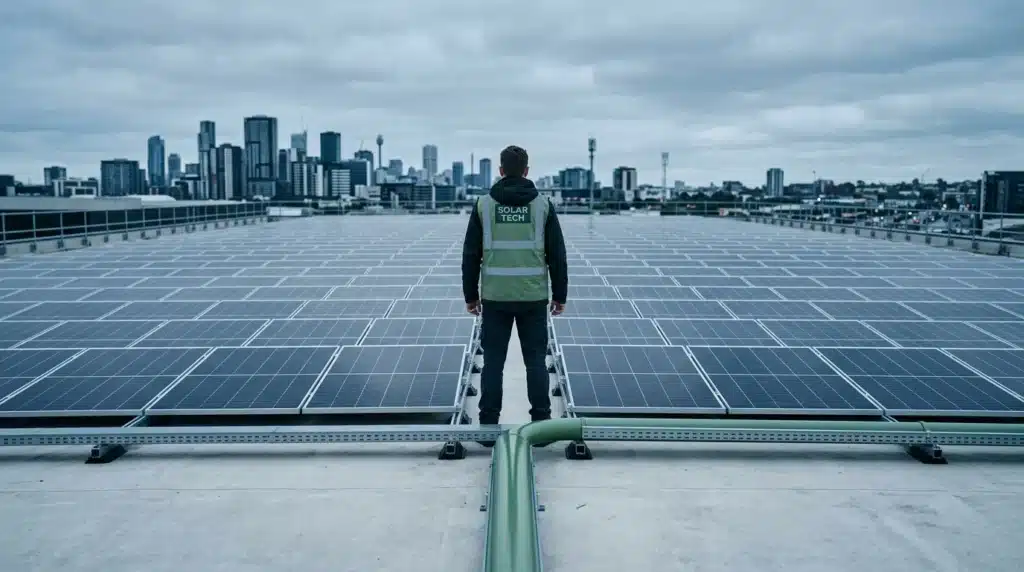
Most businesses approach solar with a dangerously simple mindset: cover the roof with panels and watch the meter run backward. This is a recipe for leaving money on the table. A effective commercial solar installation isn’t just about generating power; it’s a strategic asset integration that requires a level of planning far beyond what residential projects demand. The goal isn’t just to be “green,” but to achieve a measurable competitive advantage through energy control.
The initial site assessment is where most mistakes are made. An expert analysis goes beyond simply measuring sunlight. It involves a deep dive into your facility’s load profile, structural engineering constraints, and local utility rate structures. What most people miss is that the most obvious location for panels might be the least profitable. A full assessment, according to the U.S. Office of Energy Efficiency & Renewable Energy, can identify efficiency upgrades that reduce a building’s baseline consumption by 10-30%, making any subsequent solar investment significantly more impactful. It’s about shrinking the target before you shoot.
Tailored Solutions: Matching Technology to Business Needs
There is no one-size-fits-all solution in commercial solar. The physical footprint of your business, your daily energy consumption patterns, and your long-term operational goals dictate the optimal system design. Choosing the right type of installation is like choosing the right vehicle for a job; you wouldn’t use a sports car to haul lumber. This decision has massive implications for cost, output, and land use.
For instance, a logistics company with a vast, unobstructed warehouse roof is a prime candidate for a traditional rooftop system. But what if your property has limited roof space or significant shading issues from nearby structures? This is where alternatives become critical. Ground-mounted arrays can be positioned for perfect solar orientation, and solar carports turn a necessary evil—parking lots—into revenue-generating assets. The data suggests that for retail locations, solar carports can increase customer dwell time by offering shaded parking, an often-overlooked secondary benefit.
Each system type presents a unique set of trade-offs that an experienced engineer must balance.
| System Type | Pros | Cons |
|---|---|---|
| Rooftop Mounted | Utilizes existing, unused space; generally lower installation cost; minimal impact on business operations. | Limited by roof size, angle, and structural capacity; potential for roof penetration issues; maintenance can be more complex. |
| Ground Mounted | Optimal panel tilt and orientation for maximum energy production; easier access for cleaning and maintenance; scalable to very large sizes. | Requires significant available land; higher initial cost due to structural supports and trenching; can have environmental/zoning hurdles. |
| Solar Carports/Canopies | Dual-purpose asset (power generation and shaded parking); highly visible statement of sustainability; can be installed over existing lots. | Highest upfront cost per watt due to steel structure; complex foundation requirements; longer construction timeline. |
Maximizing Financial Incentives for Commercial Operations
The sticker price of a commercial solar project is almost never what a business actually pays. A complex web of federal, state, and local incentives can dramatically reduce the net cost, but navigating this landscape is treacherous. Unlike the more straightforward residential credits, commercial incentives are designed to interact with corporate tax structures. This is a critical distinction.
Getting this wrong can cost you dearly. The key is to model the financial returns based on your specific tax liability and depreciation schedule, not just the raw energy savings. Dr. Anjali Sharma, an energy finance expert at the University of Chicago Booth School of Business, explains, “The most successful projects are finance-led, not just engineering-led. The interplay between tax credits, accelerated depreciation, and performance-based incentives can alter the payback period by as much as five years.”
Navigating Tax Credits and Depreciation
For businesses in the United States, the Investment Tax Credit (ITC) is a major financial driver, allowing a significant percentage of the total project cost to be deducted directly from federal tax liability. But the underrated factor here is the Modified Accelerated Cost Recovery System (MACRS). MACRS allows businesses to recover investments in certain property—solar energy equipment qualifies—through depreciation deductions over a five-year period. When combined, the ITC and MACRS can offset a substantial portion of the initial capital outlay much faster than simple energy savings alone.
This creates a powerful financial tool. Effectively, you are using pre-tax dollars to pay for a significant chunk of the system. While the principles are similar to other capital equipment purchases, the specific rules for renewables are unique and require specialized accounting expertise to maximize returns without running afoul of tax regulations.
Operational Impact: fluid Integration and Maintenance
Flipping the switch on a new solar array is not the end of the project. A system’s long-term performance hinges on its fluid integration with your existing electrical infrastructure and a proactive maintenance plan. Adding a multi-megawatt solar generator to your building’s grid is not like plugging in a new appliance; it’s more like performing an organ transplant on your facility’s energy system. It requires careful planning to ensure grid stability and safety — a core element of any project aimed at paving the way for a sustainable lifestyle on a commercial scale.
A professional installation includes detailed monitoring software that tracks performance down to the individual panel. This allows for predictive maintenance, identifying failing components before they cause significant downtime. A surprising number of businesses skimp on a maintenance contract, assuming the system is “set it and forget it.” Yet, a study by Sandia National Laboratories found that regular panel cleaning and system check-ups can prevent up to 15% in performance degradation over the system’s lifespan. This isn’t just about keeping things running; it’s about protecting the core financial assumptions that justified the project from the start, a key principle whether you’re a business or a homeowner future-proofing your property.
The ultimate goal is not just energy production, but energy reliability that enhances your core business without causing operational headaches.
The DIY and ‘cut-rate consultant’ approach is the most expensive path in the long run. I’ve seen homeowners lose thousands in unclaimed tax credits and commercial clients install systems that fail structural inspections. Is saving a few hundred dollars upfront worth a 25-year headache?
— Dr. Chloe Vance, Independent Energy Systems Analyst
| Factor | Standard Approach | Expert-Led Strategy |
|---|---|---|
| Initial Step | Get quotes for solar panels. | Conduct a full energy audit to identify efficiency gains first. |
| System Sizing | Based on roof space or a generic estimate. | Based on detailed load profiling and future needs (e.g., EVs). |
| Design | Uses a one-size-fits-all, south-facing layout. | Involves granular shade analysis and may use split arrays for optimal production. |
| Financials | Focuses on the sticker price and gross energy savings. | Models ROI using tax liability, depreciation (MACRS), and all available incentives. |
| Technology | Pushes a specific brand of panel or inverter. | Selects components (panels, inverters, batteries) tailored to the project’s specific goals. |
| Outcome | A system that generates power. | A high-performing financial asset optimized for long-term value and resilience. |
Residential Solar: Expert Blueprints for Sustainable Home Power
Let’s be blunt: most off-the-shelf residential solar packages are designed for the installer’s convenience, not your home’s peak performance. Companies often push a one-size-fits-all solution that looks good on a brochure but leaves significant energy production on the table. Achieving true energy independence requires a more tailored approach, moving beyond the simple sales pitch and into the realm of strategic system design. This is less about just buying panels and more about engineering a personal power plant.
The journey begins with a core shift in mindset. Instead of asking “How many panels can I fit on my roof?”, the correct question is “What are my precise energy goals and how do I design a system to meet them?” For many, this is the first step in a larger plan for crafting a sustainable lifestyle with solar power. It involves a detailed audit of your consumption habits and a clear vision for your future energy needs.
Optimizing Panel Placement and System Size
Anyone can tell you to use your south-facing roof. That is entry-level advice. What most people miss is that a professional assessment involves a granular shade analysis for every hour of the day, throughout the year. That single oak tree in your neighbor’s yard might seem harmless, but if it casts a shadow over your array from 3 PM onward, it could slash your production by up to 22%, according to studies from the Fraunhofer Institute for Solar Energy Systems.
This is why a rigid, south-facing orientation isn’t always optimal. Sometimes, a split-array facing southeast and southwest provides a more consistent production curve that better matches a family’s morning and evening energy spikes. Sizing the system is another area rife with error. It’s not about maximizing kilowatt-hours; it’s about matching your actual usage patterns. Oversizing a system in areas with low net metering compensation is like overfilling a glass of water — the excess just spills over with no benefit to you, extending your financial breakeven point unnecessarily. If you’re just starting, understanding these basics is a good foundation, and our beginner’s guide to residential solar can help fill in the gaps.
The Role of Battery Storage in Residential Autonomy
Solar panels without battery storage simply make you a part-time power generator for the utility company. A battery system is what transforms your home into an energy fortress. It’s the critical component that provides resilience during grid outages and, more importantly, allows you to strategically use your own stored energy when utility rates are at their highest. This is where you start playing offense against your power bill.
The choice of battery is far from trivial. Lithium Iron Phosphate (LFP) batteries, for example, offer a longer lifespan and superior thermal stability compared to some older Nickel Manganese Cobalt (NMC) chemistries, making them a preferred choice for residential safety. What does this mean for you? It means you can disconnect from the grid during peak evening hours, running your home on stored sunshine while your neighbors are paying premium rates. This strategic energy use is a core principle behind some of the most exciting future-proofing trends in home energy.
Before you even speak to an installer, a little preparation goes a long way. Having the right information on hand ensures you lead the conversation and get a system designed for your needs, not their sales quota. Here is a checklist of what to have ready:
- 12 Months of Utility Bills: This provides a clear picture of your seasonal energy consumption and peak demand.
- Your Primary Goal: Are you aiming for maximum savings, 100% grid independence, or simply backup power for outages? Be specific.
- Roof Information: Know the age and material of your roof. An installer will need to confirm its structural integrity.
- Future Plans: Do you plan to buy an electric vehicle or install a heat pump in the next five years? Your system should be sized to accommodate future load increases.
- A List of Questions: Ask about panel and inverter warranties, the installer’s workmanship guarantee, and the specific equipment they propose using.
Armed with this data, you shift the dynamic from being a passive buyer to an informed project manager, ready to build a efficient home power system.
Integrating Energy Efficiency: A Holistic Approach Recommended by Professionals
Installing solar panels without first addressing energy efficiency is like trying to fill a leaky bucket with water. You can pour all the solar-generated electricity you want into your property, but if it’s hemorrhaging energy through poor insulation and outdated appliances, you’re fighting a losing battle. The professionals know this. What most property owners miss is that solar power isn’t just about generation; it’s about optimizing consumption.
A effective energy strategy treats solar panels and efficiency measures as two sides of the same coin. According to the U.S. Department of Energy, a combined approach can reduce a building’s net energy consumption far more than either strategy alone, with some integrated projects seeing a 50-70% drop in utility bills. This isn’t just about saving money. It’s about designing a smaller, more cost-effective solar system from the start. Why pay for a 10kW system when a 6kW system would suffice in a well-sealed, efficient building?
Auditing Your Property for Hidden Energy Leaks
Before you even think about smart thermostats, you need to address the physical integrity of your building. We’re talking about the building envelope—the barrier between the conditioned interior and the outside world. This includes your walls, roof, windows, and foundation. It is the single most overlooked aspect for those new to solar, who often prefer the flashier tech solutions.
A professional energy audit is the first step. Experts use tools like blower door tests to depressurize a building, revealing every tiny crack and gap where air is escaping. Infrared cameras can then pinpoint thermal bridges and areas with missing insulation. Dr. Kenji Tanaka, an architectural engineer, states that “up to 30% of a building’s heating and cooling energy loss can be attributed to air leaks alone.” Sealing these leaks and upgrading insulation provides a constant, passive reduction in energy demand that works 24/7. It’s the foundational work that makes every other investment more effective, and a key part of any serious plan for integrating solar for a sustainable lifestyle.
Smart Technologies for Smarter Energy Use
Once your building’s physical shell is secured, technology can optimize what happens inside. Smart thermostats are a good start, but the real gains come from a more connected system. Modern smart panels and energy monitors can track your solar production in real-time and compare it against your consumption. This data is powerful.
It allows for intelligent “load shifting.” For example, the system can automatically run high-demand appliances like a dishwasher or EV charger in the middle of the day when your solar production is at its peak. This maximizes your use of free, self-generated power and minimizes reliance on the grid. Many homeowners are exploring these cutting-edge energy efficiency trends to future-proof their properties. Some advanced systems even monitor weather forecasts to pre-cool a building on a hot afternoon before peak grid prices kick in (a neat trick that saves a surprising amount).
Ultimately, this integration transforms your property from a passive consumer of energy into an active, intelligent participant in its own power management. It’s a underlying shift required for true energy independence.
Future-Proofing Your Investment: Long-Term Outlook and Maintenance
You think bolting panels to your roof is the finish line? Think again. Treating your solar array as a “set it and forget it” appliance is the fastest way to undermine your own investment. Ignoring your system is like never changing the oil in your car; it works fine for a while, until it suddenly and expensively doesn’t. The underrated factor here is that performance degradation isn’t always obvious without proactive monitoring.
Most manufacturers offer lengthy performance warranties, but are you actually reading the fine print? These guarantees often require proof of basic upkeep. Data from the National Renewable Energy Laboratory (NREL) suggests that uncleaned or poorly maintained panels can lose between 3-5% of their efficiency annually, with some studies showing losses as high as 20% in dusty or polluted areas. That’s real money leaking out of your system every day. Actively managing your array is a core part of a sustainable lifestyle, not just a one-time purchase.
An annual check-up by a certified professional is non-negotiable. For the hands-on owner, consistent self-monitoring can catch issues before they escalate. Here are the necessary checks experts recommend:
- Visual Inspection: Look for cracked glass, corrosion on the racking, or loose wiring. Document any changes with photos.
- Inverter Health Check: Ensure the inverter is operating correctly, with no fault lights or unusual error codes displayed.
- Performance Monitoring: Compare current output with historical data. A sudden drop of more than 5-7% that isn’t related to weather warrants a closer look.
- Debris and Shading Audit: Clear any accumulated leaves or dirt from the panels (following manufacturer safety guidelines) and trim any new tree growth causing shadows.
Beyond simple cleaning, the technology itself is constantly advancing. Professionals are closely watching trends like bifacial panels that capture reflected light and the commercial viability of perovskite solar cells. Staying informed about these emerging energy efficiency trends ensures that when it’s time to upgrade or expand, you’re making the smartest choice for the next two decades, not just for today.
Your Next Question: Choosing the Right Architect for Your Power Plant
Understanding the difference between a basic installation and an expert-led project is the first important step. Now that you’re armed with the knowledge of what’s at stake—from financial incentives to long-term performance—the focus inevitably shifts. The most important decision isn’t which panel to buy, but which expert to trust. As you move forward, how will you vet a potential partner to ensure they are the architect your investment deserves, capable of navigating the technical, financial, and regulatory complexities to deliver on the promise of energy independence?
Frequently Asked Questions
What’s the typical lifespan of a professionally installed solar system?
A high-quality, professionally installed solar system is designed to last for 25 to 30 years. The solar panels themselves are durable and come with a performance warranty guaranteeing a certain production level after two decades. The inverter, which converts DC to AC power, typically has a shorter lifespan of 10-15 years and should be considered a planned replacement.
How do experts assess the best solar solution for different property types?
Experts conduct a detailed site assessment that goes far beyond sunlight exposure. They analyze the last 12-24 months of your energy bills to create a load profile, perform a structural analysis of the roof or ground, and use specialized software for a granular shade analysis. This data, combined with your financial goals, determines the optimal system size, panel placement, and technology (like battery storage).
What are the most common mistakes people make when going solar, and how can they be avoided?
The most common mistakes include ignoring energy efficiency improvements before sizing a system, choosing an installer based solely on the lowest price, and misunderstanding the financial incentives. To avoid these, first invest in an energy audit, vet installers for their experience and warranties, and work with a professional who can accurately model the impact of tax credits and depreciation on your specific financial situation.
Can solar power make a commercial property energy independent?
While achieving 100% off-grid independence is technically possible, it’s often not the most cost-effective goal for a commercial property. a strategically designed solar and battery storage system can provide near-total independence during business hours, offer resilience during grid outages, and give the business significant control over energy costs by avoiding peak demand charges. This creates a powerful competitive advantage.
What ongoing support should I expect from a solar installation expert?
A reputable solar expert’s job isn’t done after installation. You should expect strong support including access to a performance monitoring platform to track your system’s output. Many also offer proactive maintenance plans, which include regular panel cleaning and system check-ups, as well as handling any warranty claims on your behalf to ensure long-term performance.