Commercial Solar Financing in 2026: Exploring PACE Programs and Their 100% Project Funding Potential
As we navigate the evolving landscape of energy independence and sustainability, businesses across various sectors are increasingly recognizing the profound benefits of adopting solar power. The year 2026 stands as a pivotal moment, with advancements in technology, supportive policies, and innovative financing mechanisms making commercial solar more accessible and attractive than ever before. Central to this transformation are Property Assessed Clean Energy (PACE) programs, which offer a unique and powerful pathway to 100% project funding for commercial solar installations. This comprehensive guide delves into the intricacies of commercial solar PACE financing, examining its structure, advantages, challenges, and what the future holds for businesses looking to harness the power of the sun.
The Dawn of a New Era: Why Commercial Solar in 2026?
The drive towards sustainable operations is no longer just an environmental imperative; it’s a strategic business advantage. In 2026, the confluence of several factors makes commercial solar an undeniable opportunity:
- Technological Advancements: Solar panel efficiency continues to climb, while manufacturing costs decrease, leading to more power generation per square foot and faster payback periods.
- Energy Cost Volatility: Businesses are seeking refuge from unpredictable energy prices. Solar offers a hedge against fluctuating utility rates, providing long-term cost stability.
- Corporate Social Responsibility (CSR): Consumers, investors, and employees increasingly favor businesses committed to environmental stewardship. Adopting solar significantly boosts a company’s green credentials.
- Government Incentives: While specific incentives can vary, federal, state, and local governments continue to offer tax credits, grants, and other programs to encourage renewable energy adoption, making projects more financially viable.
- Resilience and Energy Independence: On-site solar generation can enhance energy resilience, particularly when coupled with battery storage, reducing reliance on the grid and mitigating risks from power outages.
However, despite these compelling benefits, the initial capital outlay for a significant commercial solar installation can still be a barrier for many businesses. This is where innovative financing solutions, particularly commercial solar PACE programs, come into play, effectively bridging the gap between aspiration and implementation.
Understanding Commercial Solar PACE Programs
What is PACE Financing?
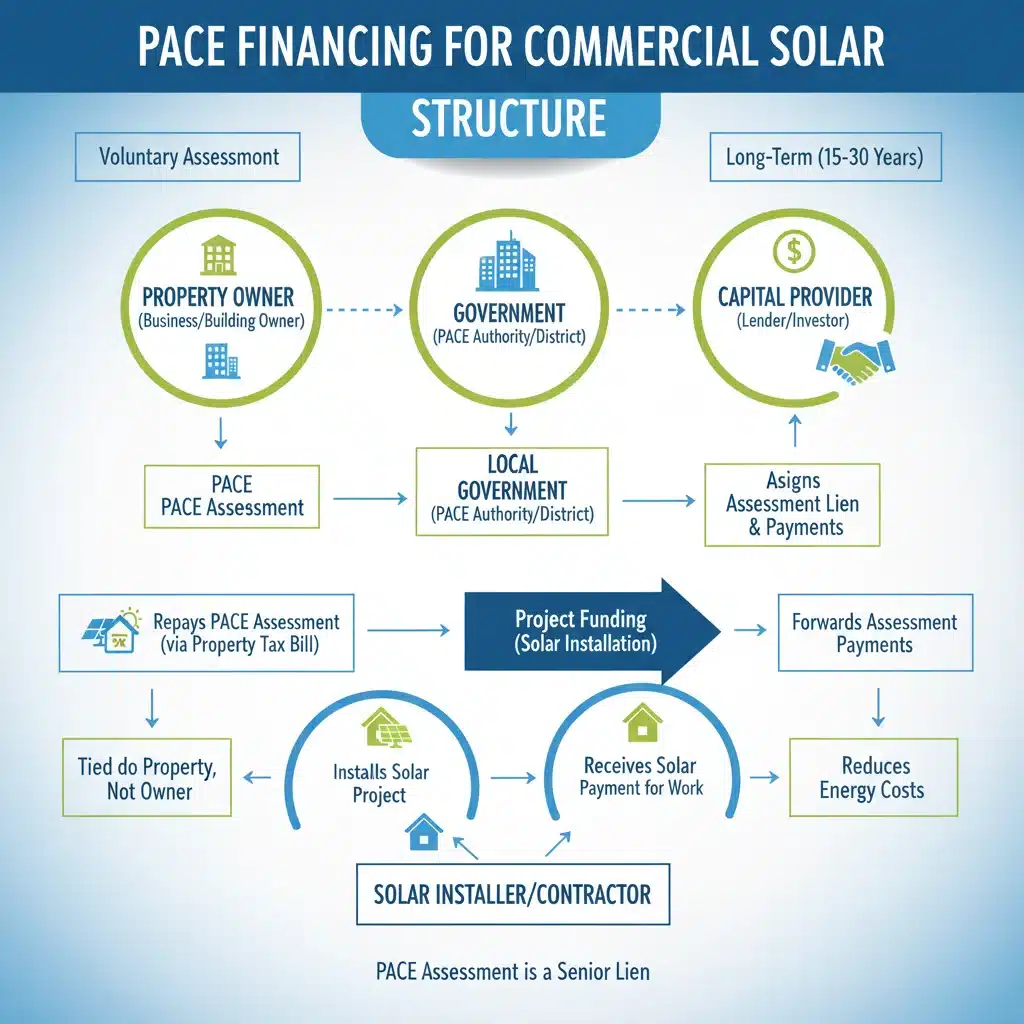
Property Assessed Clean Energy (PACE) is a unique financing mechanism that allows property owners to fund energy efficiency, renewable energy, and water conservation upgrades through a voluntary assessment on their property tax bill. Unlike traditional loans, the PACE assessment is tied to the property itself, not the individual or business owner. This crucial distinction has several significant implications that make it particularly attractive for commercial solar projects.
How Does Commercial Solar PACE Work?
- Eligibility: A commercial property owner identifies an eligible energy improvement project, such as a solar panel installation. The property must be located in a jurisdiction where PACE programs are active.
- Application and Approval: The owner applies for PACE financing through an approved program administrator or lender. The application typically includes project details, energy savings estimates, and property information.
- Funding: Once approved, the PACE provider funds 100% of the project costs, including equipment, installation, and associated soft costs. This eliminates the need for a significant upfront capital investment from the property owner.
- Repayment through Property Taxes: The financing is repaid over an extended period (typically 10-30 years) through an additional line item on the property’s annual tax bill. This assessment mechanism means the obligation transfers with the property if it’s sold.
- Installation and Savings: The solar project is installed, and the business begins to realize immediate energy savings, which often offset or even exceed the PACE assessment payments, leading to positive cash flow from day one.
Key Characteristics and Benefits of Commercial Solar PACE
The structure of PACE financing offers several distinct advantages, especially for large-scale commercial solar projects:
- 100% Project Funding: This is perhaps the most significant benefit. PACE programs can cover the entire cost of a solar installation, including design, permitting, equipment, and installation. This eliminates the need for businesses to tie up working capital or seek traditional bank loans that often require substantial down payments.
- No Upfront Capital: Businesses can undertake significant energy upgrades without any initial cash outlay, preserving liquidity for core operations or other investments.
- Long Repayment Terms: PACE assessments typically have terms of 10 to 30 years, aligning the repayment period with the useful life of the solar assets. This longer term results in lower annual payments, enhancing cash flow.
- Positive Cash Flow: Because the energy savings often begin immediately and can be greater than the annual PACE payment, many businesses experience positive cash flow from the outset.
- Property-Attached Debt: The assessment is tied to the property, not the business owner. If the property is sold, the remaining PACE obligation can transfer to the new owner, as they will be the beneficiary of the ongoing energy savings. This is particularly attractive for long-term investments like solar.
- Improved Property Value: Energy-efficient upgrades, especially solar installations, can significantly enhance a property’s market value and attractiveness to potential tenants or buyers.
- Off-Balance Sheet Potential: Depending on accounting treatment, PACE financing can sometimes be structured to be off-balance sheet, which can be advantageous for a company’s financial reporting.
- Credit Agnostic: While property owners must be current on their property taxes, PACE financing is generally not based on the business owner’s personal or corporate credit score. Instead, it relies on the property’s value and the projected energy savings.
The Role of PACE in Driving Commercial Solar Adoption in 2026
In 2026, as the urgency for climate action intensifies and businesses seek greater operational efficiencies, commercial solar PACE is poised to play an even more critical role. It democratizes access to solar energy for a broader range of commercial properties, including those that might not qualify for traditional financing due to credit constraints or insufficient collateral. By de-risking the investment and aligning financial obligations with energy benefits, PACE programs facilitate the rapid deployment of renewable energy infrastructure.
Who Benefits Most from Commercial Solar PACE?
- Property Owners with Long-Term Holdings: Businesses that plan to own their properties for many years can fully capitalize on the long-term savings and property value enhancement.
- Businesses with High Energy Consumption: Manufacturing facilities, large retail stores, cold storage facilities, and data centers stand to gain substantial savings from reduced electricity bills.
- Companies Seeking Sustainable Branding: PACE allows businesses to invest in green initiatives without straining capital budgets, enhancing their public image and meeting CSR goals.
- Organizations with Limited Capital Budgets: Small to medium-sized enterprises (SMEs) and non-profits often struggle with upfront costs for large infrastructure projects. PACE offers a viable solution.
- Properties in PACE-Enabled Jurisdictions: The primary requirement is that the property must be located in a state and local jurisdiction that has enabled PACE legislation and established a program.
Navigating the Challenges and Considerations
While the benefits of commercial solar PACE are substantial, it’s essential to consider potential challenges and nuances:
- Geographic Limitations: PACE programs are not available in all states or even all municipalities within states that have enabled PACE legislation. Availability is a key determinant.
- Lender Consent: In many cases, existing mortgage holders on a property must consent to the PACE assessment, as it typically takes a senior lien position to the mortgage. This can sometimes be a hurdle, though lender consent rates have improved over time as PACE becomes more established.
- Administrative Complexity: While the concept is straightforward, the application process can involve multiple stakeholders and require careful documentation, including energy audits and project proposals.
- Interest Rates and Fees: While competitive, it’s crucial to compare PACE interest rates and associated fees with other financing options to ensure the most cost-effective solution. Transparency in all costs is vital.
- Property Sale Implications: While the assessment transfers with the property, potential buyers need to be fully informed about the PACE obligation. Clear disclosure is paramount.
Despite these considerations, the robust framework of PACE programs, combined with increasing familiarity among lenders and property owners, makes it an increasingly streamlined and reliable financing option for commercial solar in 2026.
Beyond Solar: PACE for Comprehensive Energy Solutions
It’s important to remember that PACE programs are not exclusively for solar. They can fund a wide array of energy efficiency and renewable energy improvements, including:
- HVAC system upgrades
- LED lighting retrofits
- Building envelope improvements (insulation, windows)
- Water efficiency measures
- Roof replacements (if tied to energy savings)
- Energy storage solutions
This holistic approach means that businesses can leverage commercial solar PACE to implement a comprehensive energy strategy, maximizing savings and environmental impact across their entire facility.

The Future of Commercial Solar Financing with PACE in 2026 and Beyond
Looking ahead, the trajectory for commercial solar PACE financing is one of continued growth and refinement. Several trends are likely to shape its evolution:
- Expansion into New Jurisdictions: More states and local governments are expected to adopt PACE legislation, broadening its geographic reach and making it accessible to more businesses.
- Standardization and Streamlining: As PACE programs mature, there will likely be greater standardization of processes and documentation, making it easier for property owners and lenders to engage.
- Integration with Other Incentives: PACE will continue to be a powerful tool when combined with federal tax credits (like the Investment Tax Credit – ITC), state rebates, and depreciation benefits. The ability to stack these incentives significantly enhances the financial returns of solar projects.
- Focus on Resilience: With increasing climate-related events, PACE programs may increasingly emphasize projects that enhance energy resilience, such as solar-plus-storage solutions, which can keep businesses operational during grid outages.
- Growing Investor Confidence: As the asset class becomes more established, investor confidence in PACE-backed securities will likely grow, potentially leading to even more competitive financing terms.
- Technological Integration: The rise of smart building technologies and advanced energy management systems will further integrate with PACE-funded projects, allowing for even greater optimization and verifiable savings.
The landscape of commercial energy is shifting rapidly, and businesses that proactively adopt sustainable practices are positioning themselves for long-term success. PACE financing provides a critical lever, enabling these transformations without compromising financial stability.
Case Studies: Real-World Impact of Commercial Solar PACE
Consider a manufacturing facility struggling with high electricity bills. Through a commercial solar PACE program, they were able to finance a 500 kW rooftop solar array. The project required no upfront capital, and the estimated annual energy savings of $75,000 immediately exceeded their PACE assessment payments of $60,000, creating a positive cash flow of $15,000 in the first year. Over the 20-year term, they anticipate millions in savings, significantly reducing operational costs and improving their environmental footprint.
Another example involves a multi-tenant office building. The property owner used PACE to fund not only a solar installation but also an HVAC upgrade and LED lighting retrofit. The combined projects led to a 30% reduction in common area utility expenses, making the building more attractive to tenants and increasing its net operating income. The PACE assessment was repaid through the property tax bill, and the benefits were shared between the owner (through increased property value) and tenants (through lower operating expenses).
These examples underscore the versatility and tangible financial benefits that PACE programs deliver, making significant energy upgrades achievable for a diverse range of commercial properties.
Steps to Pursue Commercial Solar PACE Financing
If your business is considering a solar installation and exploring commercial solar PACE, here are recommended steps:
- Verify PACE Availability: Confirm that PACE programs are active and available in your specific county or municipality. Resources like the PACE Nation website can be helpful.
- Conduct an Energy Audit: Obtain a professional energy audit to identify potential energy savings opportunities and accurately size your solar system.
- Engage with Solar Developers: Work with experienced commercial solar developers who understand PACE financing and can design a system tailored to your energy needs and property characteristics.
- Connect with PACE Providers: Engage with approved PACE program administrators or capital providers who can guide you through the application process and provide financing terms.
- Consult Legal and Financial Advisors: It’s always prudent to consult with legal counsel and financial advisors to fully understand the implications of PACE financing on your property and business.
- Secure Lender Consent (if applicable): If your property has an existing mortgage, prepare to work with your mortgage lender to secure their consent for the PACE assessment.
Conclusion: Powering Business with Commercial Solar PACE in 2026
The year 2026 represents a golden opportunity for businesses to embrace solar energy, driven by technological advancements, environmental consciousness, and compelling financial incentives. At the forefront of this opportunity is commercial solar PACE financing, a robust mechanism that provides 100% project funding, long repayment terms, and the potential for immediate positive cash flow. By decoupling the significant upfront costs from the profound long-term benefits, PACE empowers businesses to invest in sustainable energy solutions, reduce operational expenses, enhance property value, and demonstrate a commitment to a greener future. As the programs continue to expand and evolve, PACE will undoubtedly remain a cornerstone of commercial renewable energy adoption, paving the way for a more sustainable and energy-independent economy.