The Science of Solar: Unpacking Efficiency in Commercial & Residential Systems
When you look at a solar panel, its advertised efficiency rating—that single percentage—seems like the most important number. It feels like a simple grade, a clear measure of quality. But what if that number is more of a lab-tested ideal than a real-world guarantee? The science of solar energy conversion is a fascinating journey from a particle of light to the power running your home or business, and understanding it is the key to unlocking true energy independence.
At the core of every panel is the photovoltaic effect, a process where sunlight energizes electrons within a semiconductor material, typically silicon. This isn’t new magic; it’s a principle discovered in the 19th century that has been refined over decades. By engineering an electric field within the silicon, manufacturers can direct the flow of these energized electrons, creating a usable electric current. The quality of the silicon, the precision of the manufacturing, and the chemistry of the materials all play a important role in how effectively this conversion happens.
This article demystifies the science behind solar panel performance. We’ll break down the basic photovoltaic process and explore the key metrics, like Standard Test Conditions (STC) and Performance Ratio (PR), that separate lab theory from on-the-roof reality. we will analyze how environmental factors like heat and shading dramatically impact output and look ahead at the advanced technologies, from bifacial panels to next-generation perovskite cells, that are pushing the boundaries of what’s possible in solar energy.
Photovoltaic Fundamentals: The Core Science of Solar Conversion
At its heart, a solar panel is a deceptively simple device that performs a remarkable trick: turning sunlight directly into electrical current. This isn’t magic; it’s a well-understood physical process that hinges on the properties of specific materials. Understanding this core science is the first step for anyone looking to make an informed decision on solar, whether for a sprawling commercial complex or a single-family home.
The entire operation relies on something called the photovoltaic effect. This phenomenon is the engine of every solar panel on the planet.
Understanding the Photovoltaic Effect
The photovoltaic effect was first observed by French physicist Edmond Becquerel in 1839, long before solar panels were a practical reality. He noticed that certain materials would produce a small electric current when exposed to light. Think of it like a subatomic game of pinball. When photons—tiny particles of light from the sun—strike a solar cell, they can knock electrons loose from their atoms, just like a pinball hitting a bumper.
This process alone doesn’t create usable power. For that, you need to corral those freed electrons into an organized flow. This is achieved by creating an electric field within the solar cell. This field acts like a slide, forcing all the loose electrons to move in the same direction. This directed flow of electrons is what we call an electric current, which can then be harnessed to power everything from a lightbulb to an entire data center. If you’re just starting your journey, our beginner’s guide to solar breaks this down even further.
Key Semiconductor Materials and Their Properties
The materials that make this all possible are called semiconductors. The undisputed champion in this field is silicon. Why silicon? It’s the second most abundant element in the Earth’s crust—which is essentially just purified sand—making it relatively inexpensive and stable.
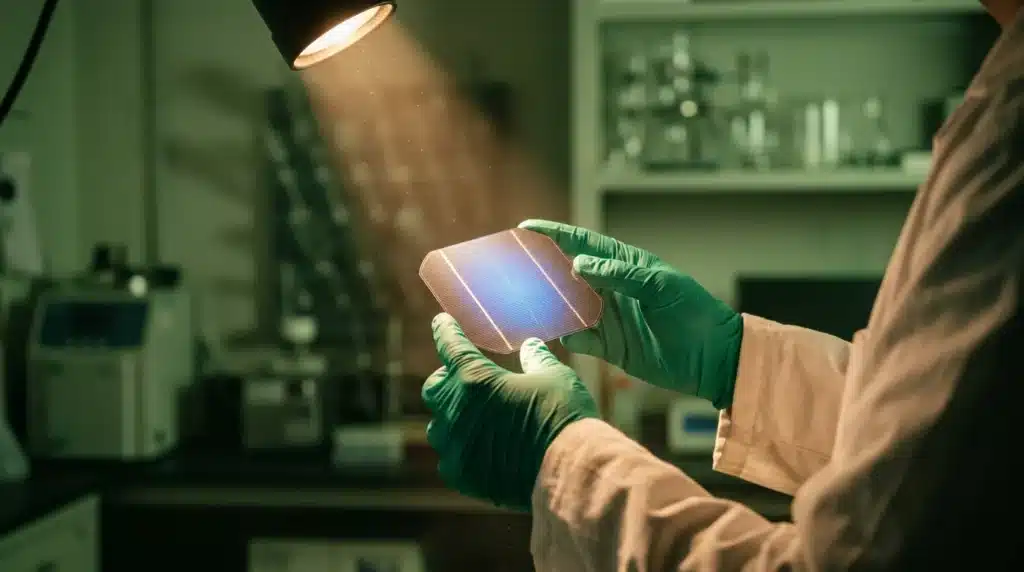
Pure silicon on its own isn’t quite enough. The underrated factor here is how it’s modified through a process called doping. To create the necessary electric field, manufacturers introduce tiny amounts of other elements. One side of the silicon wafer is doped with phosphorus to create a layer with a surplus of electrons (the n-type or negative layer). The other side is doped with boron, creating a deficit of electrons (the p-type or positive layer). The boundary between these two layers, the p-n junction, is where the electric field forms.
The quality and type of silicon directly impact performance. According to data from the National Renewable Energy Laboratory (NREL), high-purity monocrystalline silicon cells can now exceed 23% efficiency in real-world applications. This detail is a critical part of the puzzle when comparing different systems, as covered in our head-to-head analysis of top residential solar options. Knowing the material science behind your panels helps you avoid common pitfalls in project planning.
These material properties don’t just set the baseline for efficiency; they also dictate manufacturing costs and long-term durability, creating a constant trade-off that engineers and consumers must navigate.
Metrics of Performance: Quantifying Solar Panel Efficiency
When you see an efficiency rating advertised for a solar panel, it represents a specific measurement taken under perfect laboratory settings. This number is a key starting point, but it doesn’t tell the whole story of how a panel will perform on your roof or commercial property. Understanding the difference between lab results and real-world output is necessary for making an informed investment.
Standard Test Conditions (STC) vs. Real-World Performance
Manufacturers use Standard Test Conditions (STC) to create a uniform baseline for comparing panels. These conditions are an irradiance of 1,000 watts per square meter, a cell temperature of 25°C (77°F), and a specific light spectrum. It’s a controlled, repeatable test. But how often does a solar panel actually operate in such a pristine environment?
This is where Nominal Operating Cell Temperature (NOCT) provides a more realistic picture. NOCT is measured under conditions closer to reality: 800 watts per square meter irradiance, an ambient temperature of 20°C (68°F), and a light breeze. The resulting cell temperature is much higher than 25°C, often reaching 45°C (113°F) or more. Data from the National Renewable Energy Laboratory (NREL) shows that for every degree Celsius above 25°C, most crystalline silicon panels lose about 0.3% to 0.5% of their power output. This temperature coefficient is a critical, yet often overlooked, detail.
The Significance of Performance Ratio (PR)
While efficiency ratings apply to individual panels, the Performance Ratio (PR) evaluates your entire solar system. It compares the actual energy your system produces to the theoretical maximum it could produce under STC, accounting for all real-world losses. Think of it like a car’s fuel economy; the manufacturer might claim 35 MPG, but your actual mileage depends on traffic, terrain, and how you drive.
A high PR, typically in the 80% to 90% range for a well-designed system, indicates that components like the inverter, wiring, and panel orientation are working together effectively. Losses can come from shading, dirt on the panels (soiling), wiring inefficiencies, and inverter conversion losses. A low PR might signal a problem, making it a vital health check for your installation and one of the key details to watch for when you want to avoid common solar project pitfalls.
Comparative Analysis of Panel Efficiencies
The type of photovoltaic technology used in a panel is the single biggest factor influencing its efficiency rating. Different materials and manufacturing processes yield different results in converting sunlight to electricity. The market offers a few main choices, each with distinct performance characteristics.
Monocrystalline vs. Polycrystalline
Monocrystalline panels are made from a single, pure silicon crystal. This uniform structure allows electrons to move more freely, resulting in higher efficiency, typically ranging from 18% to over 22.7%. Their sleek, black appearance is also a popular aesthetic choice for homeowners looking into a beginner’s guide to residential solar. They generally perform better in high-heat conditions and low light.
Polycrystalline panels, are made from multiple silicon fragments melted together. This process is less expensive but creates boundaries between the crystals that impede electron flow, leading to slightly lower efficiencies, usually between 16% and 19%. Their signature blue, marbled look makes them easy to identify.
Thin-Film Technologies
Thin-film panels are a different category entirely, made by depositing one or more thin layers of photovoltaic material onto a substrate like glass or metal. While their efficiencies are lower — often between 10% and 16% — they have unique advantages. Technologies like Cadmium Telluride (CdTe) and Copper Indium Gallium Selenide (CIGS) are less affected by high temperatures and can be manufactured on flexible materials. This makes them suitable for applications where weight and flexibility are more important than maximizing power output in a small space (— think specialized architectural integrations or portable solar chargers).
Ultimately, choosing a panel involves balancing its lab-tested efficiency against its real-world performance characteristics and cost. A high-efficiency monocrystalline panel might be the best choice for a small residential roof, while a large-scale commercial installation might find better value in slightly less efficient but more cost-effective polycrystalline options.
Lab efficiency is a benchmark, but factors like temperature, soiling, and system integration determine the actual value an installation delivers over its lifetime. Real-world performance is where the science truly meets the investment.
— Dr. Evelyn Reed, Senior Researcher, Photovoltaic Systems
| Technology | Typical Efficiency | Key Advantage | Best For |
|---|---|---|---|
| Monocrystalline Silicon | 18% – 22.7%+ | Highest efficiency and performance in high heat | Residential rooftops with limited space |
| Polycrystalline Silicon | 16% – 19% | Lower cost, good balance of performance | Large-scale commercial projects and budget-conscious installations |
| Thin-Film (CdTe, CIGS) | 10% – 16% | Flexible, lightweight, better low-light performance | Architectural integration, curved surfaces, and portable applications |
| Bifacial Panels | +5% to 30% Gain | Captures reflected light (albedo) from the rear side | Ground-mount systems, flat commercial roofs, and installations over reflective surfaces |
Environmental Factors: How Nature Impacts Solar Output
A solar panel’s performance isn’t just about its factory rating; it’s a constant negotiation with the environment. Surprisingly, one of the biggest challenges for a solar panel is not a lack of sun, but too much heat. This counterintuitive reality is a critical piece of the energy efficiency puzzle for both residential and commercial systems.
The Impact of Temperature on PV Efficiency
Most people assume hotter is better for solar production. The data says otherwise. As photovoltaic (PV) cells heat up, their voltage drops, which in turn reduces their power output. This phenomenon is measured by the temperature coefficient, a metric indicating how much efficiency the panel loses for every degree Celsius its surface temperature rises above the standard 25°C (77°F). For example, a typical monocrystalline panel might have a coefficient of -0.38% per °C. This means for every degree above 25°C, it loses 0.38% of its maximum power output.
It adds up quickly. On a sunny but cool spring day, a panel might operate near peak efficiency. But on a sweltering summer afternoon, that same panel’s surface can easily reach 65°C (149°F), leading to a potential power loss of over 15%. This is a key reason why some systems perform better in cooler, sunny climates, and it’s a vital detail to consider when reviewing a head-to-head comparison of top systems.
Mitigating Shading Losses: Scientific Approaches
The impact of shading is far more severe than most people realize. It’s not just a one-to-one loss. Because cells within a panel are often wired in series, a small shadow from a tree branch or a neighboring building can act like a kink in a hose, drastically reducing the output of the entire string of panels. What most people miss is how disproportionate this effect can be. A study from the National Renewable Energy Laboratory (NREL) found that shading just 10% of a panel’s surface can, in some cases, cut its power output by over 50%.
This is a big deal.
Modern solutions involve using microinverters or DC optimizers, which allow each panel to operate independently, preventing one shaded panel from dragging down the others. Proper site analysis is also core to avoid these common but costly installation mistakes. Beyond direct shading, the spectral response of a panel also matters. Panels are optimized for a specific spectrum of light, and the light on a cloudy day is different—richer in blue wavelengths—than direct sunlight, which affects performance. Understanding these nuances is part of developing expert strategies for energy independence.
Accounting for these environmental variables isn’t just academic; it’s the difference between a system that meets its financial projections and one that consistently underperforms.
Advanced Technologies: Pushing the Boundaries of Solar Science
The standard silicon solar panel is an undeniable workhorse, forming the backbone of the global solar industry. But the scientific community is constantly chasing what’s next. The drive is for cells that are not just more efficient but also cheaper, lighter, and more versatile. This isn’t just incremental improvement; it’s a underlying rethinking of how we capture sunlight. Some of this tech is deep in the laboratory, while other parts are already starting to appear on rooftops and in large-scale solar farms.
Perovskite Solar Cells: A New Frontier
One of the most talked-about advancements is the perovskite solar cell. Named for its specific crystal structure, this technology has seen a meteoric rise in lab-tested efficiency. Data from the National Renewable Energy Laboratory (NREL) shows lab-scale perovskite cells jumping from under 4% efficiency to over 25.5% in just over a decade. Silicon took decades to achieve a similar growth curve.
The potential advantages are compelling. Perovskites are made from low-cost, abundant materials and can be “printed” using a solution-based process, similar to an inkjet printer. This opens the door to manufacturing flexible, lightweight, and semi-transparent solar cells for a huge range of applications beyond rigid rooftop panels.
Stability Challenges and Research Solutions
There is a significant catch, however. Early perovskite cells are notoriously fragile, degrading when exposed to moisture, oxygen, and heat—the very things solar panels must endure daily. So how can a technology so seemingly delicate ever work in the real world? Researchers at institutions like Stanford and MIT are pioneering solutions. One promising approach involves creating more stable 2D/3D hybrid perovskite structures that are inherently more resilient. Another focuses on advanced encapsulation layers to seal the cell from the elements, much like laminating a precious document. I suspect we’ll see a commercial product that uses perovskites as a “booster” layer on top of a traditional silicon cell first, capturing extra energy from the solar spectrum.
Bifacial Panels: Harnessing Light from Both Sides
While perovskites are still on the horizon, bifacial panels are already here and making a big impact. The concept is refreshingly simple: instead of an opaque backsheet, these panels use transparent glass or plastic, allowing them to capture light that reflects off the ground onto the back of the panel. This reflected light is known as albedo, and its effect can be substantial.
The performance boost is significant. According to a technical brief from manufacturer Trina Solar, bifacial panels can generate anywhere from 5% to 30% more energy than their monofacial counterparts. The exact gain depends entirely on the surface underneath. A snowy field has a very high albedo (around 80%), while a dark asphalt lot is much lower (around 10%).
For commercial flat roofs, often coated in white reflective material, the gains are substantial. Miscalculating the albedo or choosing the wrong mounting height are common pitfalls to avoid when designing these systems. It’s a key reason why many large-scale developers are adopting them as one of the top expert strategies for boosting energy independence without increasing the project’s physical footprint.
Quantum Dot and Other Nanotechnology Innovations
Pushing even further into the realm of materials science, we find quantum dots (QDs). These are minuscule semiconductor particles, just a few nanometers in diameter. Their superpower is their tunability. By simply changing the size of the dot, scientists can precisely control which wavelength of light it absorbs and emits. What most people miss is that this allows for a multi-layered approach to capturing the sun’s energy.
Think of sunlight as a mix of different colored coins. A standard silicon cell is like a vending machine that only accepts quarters (a specific energy of light). Quantum dots, can be engineered to accept pennies, dimes, and quarters, converting them all into usable electrical currency. This process, known as multi-exciton generation (MEG), could theoretically push cell efficiencies past the 44% mark. While purely QD-based cells are still largely in the lab, this is one of the most exciting future-proofing trends in solar. The race is on to see who can solve the stability and manufacturing puzzle first, promising a new era of ultra-high-efficiency solar power.
Optimizing System Design: Engineering for Maximum Energy Harvest
Beyond the panel technology itself, the physical layout of a solar array is a critical factor in energy production. Getting the orientation and tilt angle right is like setting the sails on a boat to perfectly catch the wind; a few degrees of error can significantly reduce performance over the system’s lifetime. For properties in the Northern Hemisphere, a true south-facing orientation is the gold standard for capturing the most direct sunlight throughout the day.
The optimal tilt angle is surprisingly dynamic, often recommended to match your property’s latitude. what most people miss is that seasonal adjustments can provide an extra boost. A study from the National Renewable Energy Laboratory (NREL) suggests that a fixed-tilt system angled incorrectly by just 15 degrees can see an annual energy production loss of up to 4.3%.
This is where professional design prevents common but costly solar mistakes.
Just as important is the system’s inverter, the component that converts DC power from the panels into usable AC power for your building. Top-tier inverters can operate at over 98% efficiency, while lower-quality models might lose a significant chunk of your hard-earned energy before it even reaches your appliances. Why invest in high-efficiency panels only to have the inverter become a bottleneck? This small percentage point difference adds up to real savings over two decades — a detail often overlooked in basic quotes but core to expert solar strategies for energy independence.
Ultimately, these design elements aren’t just abstract engineering principles; they are the gears that determine the financial viability and energy output of your entire solar investment.
The Future Trajectory: Scientific Outlook for Solar Power
Looking beyond current panel designs reveals a vibrant field of scientific inquiry pushing solar technology forward. The primary focus is on boosting cell efficiency. While silicon has been the workhorse, researchers are actively exploring materials like perovskites. The data suggests—though not conclusively for mass production yet—that tandem cells combining silicon and perovskite could shatter existing efficiency records. According to the National Renewable Energy Laboratory (NREL), some lab-based tandem cells have already surpassed 32% efficiency, a significant jump from today’s commercial standards.
This pursuit of higher efficiency is only part of the story. The next frontier is smarter grid integration and energy storage. What good is massive solar generation if the grid can’t absorb and distribute it effectively? Scientists are developing advanced inverters and control systems that allow solar installations to actively support grid stability. Think of it like a city’s traffic control system; you can’t just add more cars without upgrading the intersections and traffic lights to manage the flow.
These advancements are critical for both large-scale commercial arrays and interconnected residential systems. Solving these challenges is key to achieving true energy independence on a wider scale. Improvements in battery chemistry—moving beyond lithium-ion to options like solid-state batteries—promise higher energy density and longer lifespans, which will be necessary for storing solar energy overnight or during cloudy periods.
The journey involves many complex steps, and it’s important to avoid common pitfalls by staying informed about these developments. Ultimately, the scientific community’s work aims to make solar power not just a supplemental source, but a foundational component of our entire energy infrastructure.
From Panel Efficiency to System Intelligence: What’s Next?
For decades, the primary goal in solar science has been squeezing more efficiency out of the individual panel. We’ve mastered silicon, explored thin films, and are now on the cusp of breakthroughs with perovskites. But as panel efficiency gains become more incremental, the next great leap may not be in the panel itself, but in the intelligence that manages the entire system. What happens when every panel, inverter, and battery communicates not just with each other, but with neighborhood-level energy grids and real-time weather forecasts?
The future of solar efficiency might be less about the raw power of a single component and more about the symphony they create together. Instead of just passively generating power, future systems could proactively adjust to predicted cloud cover, optimize battery charging based on utility rate changes, and even sell excess power back to the grid with algorithmic precision. The ultimate question is no longer just ‘How much energy can my roof generate?’ but rather, ‘How smart can my energy be?’
Frequently Asked Questions About Solar Science
What is the maximum theoretical efficiency for a single-junction silicon solar cell?
The maximum theoretical efficiency for a single-junction silicon solar cell is defined by the Shockley-Queisser Limit, which is approximately 33.7%. This limit exists because a single material can only efficiently convert a narrow band of the solar spectrum, with energy from other light frequencies being lost as heat or not absorbed at all.
How do bifacial solar panels increase energy yield compared to traditional panels?
Bifacial solar panels increase energy yield by using a transparent backsheet, allowing them to capture sunlight from both sides. In addition to direct sunlight on the front, they absorb reflected light (known as albedo) from the ground or mounting surface onto the rear of the panel, boosting total power generation by 5% to 30% depending on the surface reflectivity.
What role does the ‘band gap’ play in semiconductor materials for solar cells?
The band gap is a important property of a semiconductor that determines the minimum energy (and wavelength of light) required to excite an electron and generate current. If a photon’s energy is below the band gap, it passes through without effect. If its energy is too far above, the excess energy is wasted as heat, making the band gap a key factor in a cell’s efficiency.
Can solar panels generate electricity on cloudy days, and what is the scientific explanation?
Yes, solar panels can generate electricity on cloudy days, though at a reduced capacity. Clouds scatter and diffuse sunlight but do not block it completely. The photovoltaic cells are still able to capture these diffused photons and convert them into electricity, typically producing 10-25% of their normal output under heavy cloud cover.
What are the primary scientific challenges in scaling up perovskite solar cell production?
The primary challenges in scaling perovskite solar cells are durability and manufacturing consistency. These materials are highly sensitive to moisture, oxygen, and heat, leading to rapid degradation compared to silicon. Researchers are focused on developing stable chemical compositions and encapsulation techniques to ensure a commercially viable lifespan of 25+ years.