Commercial Solar PPAs 2026: Fixed vs. Escalating Rates Explained
In the rapidly evolving landscape of commercial energy, businesses are increasingly turning to solar power as a strategic investment. Not only does it offer significant environmental benefits, but it also presents a compelling financial proposition. Among the various financing mechanisms available, the Power Purchase Agreement (PPA) stands out as a popular choice for many organizations looking to adopt solar without the upfront capital expenditure. As we look towards 2026, understanding the nuances of different PPA structures, particularly the distinction between fixed and escalating rates, becomes paramount for making informed decisions.
A commercial solar PPA allows businesses to purchase electricity generated by a solar energy system installed on their property, owned and maintained by a third-party developer, at a predetermined rate. This arrangement effectively removes the burden of ownership, operation, and maintenance from the business, making solar adoption more accessible. However, the exact financial terms of a PPA can vary significantly, with the rate structure being one of the most critical factors. This comprehensive guide will delve deep into fixed versus escalating rate PPAs, offering insights crucial for businesses navigating their solar journey in 2026 and beyond.
Understanding the Commercial Solar PPA Landscape in 2026
The year 2026 is poised to be a pivotal time for commercial solar energy. With continued advancements in solar technology, decreasing installation costs, and a growing global emphasis on sustainability, the attractiveness of solar PPAs is set to soar. Government incentives, tax credits, and corporate sustainability goals are all contributing to a robust market for commercial solar solutions. For businesses, embracing solar isn’t just about reducing their carbon footprint; it’s about achieving long-term energy cost stability, enhancing brand image, and gaining a competitive edge.
Before diving into the specifics of rate structures, it’s essential to grasp the fundamental benefits of a commercial solar PPA:
- Zero Upfront Costs: Businesses can install solar panels on their premises without any initial investment. The developer covers all design, procurement, installation, and maintenance costs.
- Predictable Energy Costs: PPAs offer a hedge against volatile utility prices, providing a more stable and predictable energy expense over the contract term, often 15-25 years.
- No Operational Burden: The PPA provider is responsible for the performance and maintenance of the solar system, alleviating the host business from technical responsibilities.
- Environmental Benefits: Businesses can significantly reduce their carbon emissions, contributing to sustainability goals and improving their public image.
- Increased Property Value: A solar installation can enhance the value of a commercial property.
However, the long-term financial implications of a PPA heavily depend on the chosen rate structure. Let’s explore the two primary options: fixed rates and escalating rates.
Fixed-Rate Commercial Solar PPAs: Stability and Predictability
A fixed-rate commercial solar PPA is perhaps the most straightforward and often the most appealing option for businesses prioritizing budgetary certainty. In this model, the price per kilowatt-hour (kWh) of electricity generated by the solar system remains constant throughout the entire term of the agreement. This means that from day one until the contract’s end, your business pays the same rate for solar electricity.
Advantages of Fixed-Rate PPAs:
- Budgetary Certainty: The most significant benefit is the absolute predictability of energy costs. Businesses can forecast their electricity expenses with high accuracy for the duration of the contract, making financial planning much simpler. This is particularly valuable for organizations with tight budgets or those seeking to minimize financial surprises.
- Simplicity: Fixed rates are easy to understand and manage. There are no complex calculations or annual adjustments to track, simplifying accounting and financial reporting.
- Protection Against Price Volatility: In regions with historically unstable utility rates, a fixed PPA offers a strong hedge. If conventional electricity prices spike, your business is shielded from those increases, potentially leading to substantial savings over time.
- Immediate Savings Potential: Often, the fixed PPA rate is set below the current utility rate, providing immediate savings from the moment the solar system becomes operational.
Disadvantages of Fixed-Rate PPAs:
- Missed Opportunity for Lower Future Costs: While fixed rates protect against rising prices, they also mean your business won’t benefit if utility rates happen to decrease significantly in the future (though this is historically less common).
- Potentially Higher Initial Rate: To account for the risk of future utility price increases, developers might set the initial fixed rate slightly higher than an escalating rate PPA’s starting point.
- Less Flexibility: Once a fixed rate is established, it’s generally non-negotiable for the contract term, offering less flexibility if market conditions drastically change.
For businesses that value stability and long-term financial predictability above all else, a fixed-rate commercial solar PPA can be an excellent choice. It provides a clear, consistent path to reducing energy expenses and achieving sustainability goals without the headache of fluctuating costs.
Escalating-Rate Commercial Solar PPAs: Balancing Initial Savings with Future Projections
In contrast to fixed rates, an escalating-rate commercial solar PPA starts with a lower initial price per kWh, but this price increases by a predefined percentage each year over the contract term. This annual escalation rate is typically modest, often ranging from 1% to 3%.

Advantages of Escalating-Rate PPAs:
- Lower Initial Costs: The primary appeal of an escalating-rate PPA is its lower starting price. This can make solar adoption more financially attractive in the short term, especially for businesses with immediate budget constraints.
- Enhanced Early Savings: With a lower initial rate, businesses can realize greater savings on their electricity bills in the early years of the contract compared to a fixed-rate PPA, assuming the fixed rate was higher.
- Alignment with Utility Rate Trends: Historically, utility electricity prices have risen over time. An escalating PPA can be structured to track these anticipated increases, ensuring that the solar rate remains competitive with or below conventional utility rates for a significant portion of the contract.
- Flexibility for Future Growth: The lower initial cost can free up capital for other business investments in the short term.
Disadvantages of Escalating-Rate PPAs:
- Increasing Costs Over Time: The most obvious drawback is that your electricity costs will increase annually. While the escalation rate is typically small, it means less predictable long-term costs compared to a fixed rate.
- Potential for Higher Costs Later in the Term: Towards the end of a long contract, the escalating rate could potentially surpass the then-current utility rate, diminishing the savings or even making solar more expensive. This risk needs careful modeling and analysis based on projected utility rate trends.
- More Complex Financial Projections: Forecasting long-term energy costs requires accounting for the annual escalation, which can make financial planning slightly more complex than with a fixed rate.
- Risk if Utility Rates Decline: If utility rates unexpectedly decline or remain stagnant for an extended period, the escalating PPA rate might become less competitive sooner than anticipated.
Escalating-rate PPAs are often favored by businesses that prioritize immediate cost savings and believe that the annual escalation will be offset by or remain below the natural increase in traditional utility rates over the contract’s lifetime.
Key Considerations for Choosing Between Fixed and Escalating Rates in 2026
The decision between a fixed and an escalating rate commercial solar PPA is not one-size-fits-all. It requires a thorough analysis of several factors specific to your business and its operating environment. Here’s what to consider in 2026:
1. Your Business’s Financial Stability and Risk Tolerance:
- Fixed Rate: Ideal for businesses that require absolute budget certainty and have a low tolerance for financial risk. It provides a clear, predictable expense line for years.
- Escalating Rate: Suitable for businesses that are comfortable with a slight increase in costs over time, perhaps because they anticipate revenue growth that will easily absorb these increases, or they prioritize lower initial expenses.
2. Local Utility Rate Forecasts:
- Research historical utility rate trends in your region and consult with energy experts for future projections. If utility rates are expected to rise significantly, a fixed rate might offer better long-term savings. If they are expected to remain relatively stable or even decline, an escalating rate with a low escalation might be more competitive initially.
- Consider regulatory changes and market dynamics that could impact future utility prices.
3. Contract Length:
- PPAs typically range from 15 to 25 years. The longer the contract, the more significant the impact of annual escalations. For very long contracts, a fixed rate might offer more peace of mind, or a very low escalation rate might be crucial for an escalating PPA.
4. Discount Rate and Time Value of Money:
- A dollar saved today is worth more than a dollar saved tomorrow. Escalating rates offer greater savings in the initial years, which can be beneficial if your business has a high discount rate or prefers to maximize early cash flow.
5. Exit Strategy and End-of-Term Options:
- Understand the options at the end of the PPA term. These typically include purchasing the system, renewing the PPA, or having the system removed. The financial implications of these options can be influenced by the PPA rate structure.
6. Environmental Goals and Public Image:
- While both PPA types contribute to sustainability, the financial structure primarily impacts your bottom line, not the environmental benefit itself. However, a financially sound PPA ensures the long-term viability of your solar commitment.
Modeling Your Commercial Solar PPA in 2026: A Financial Deep Dive
To make the best decision, businesses should perform a detailed financial analysis, comparing the net present value (NPV) of both fixed and escalating rate scenarios against their current utility costs. This involves:
- Gathering Utility Data: Collect at least 12-24 months of historical utility bills to understand your consumption patterns and current blended electricity rate.
- Obtaining PPA Quotes: Solicit proposals from multiple reputable solar developers for both fixed and escalating rate PPAs. Pay close attention to the proposed initial rate, the annual escalation percentage, and the contract term.
- Forecasting Utility Rate Increases: This is a critical and often challenging step. Use historical data, reputable energy market reports, and conservative estimates. A common approach is to assume a modest annual increase (e.g., 2-4%) in utility rates.
- Calculating Total Costs Over Time: Project the total electricity costs for each PPA scenario (fixed and escalating) over the entire contract term. Compare these against the projected costs of remaining with your current utility provider.
- Performing a Net Present Value (NPV) Analysis: This financial metric helps you compare the value of money saved or spent at different points in time. It discounts future cash flows to their present value, providing a more accurate comparison of the true financial benefit of each PPA option.
- Considering Tax Implications and Incentives: While PPAs typically mean the developer receives tax credits (like the ITC), some state or local incentives might indirectly benefit the host business or influence the PPA rate.
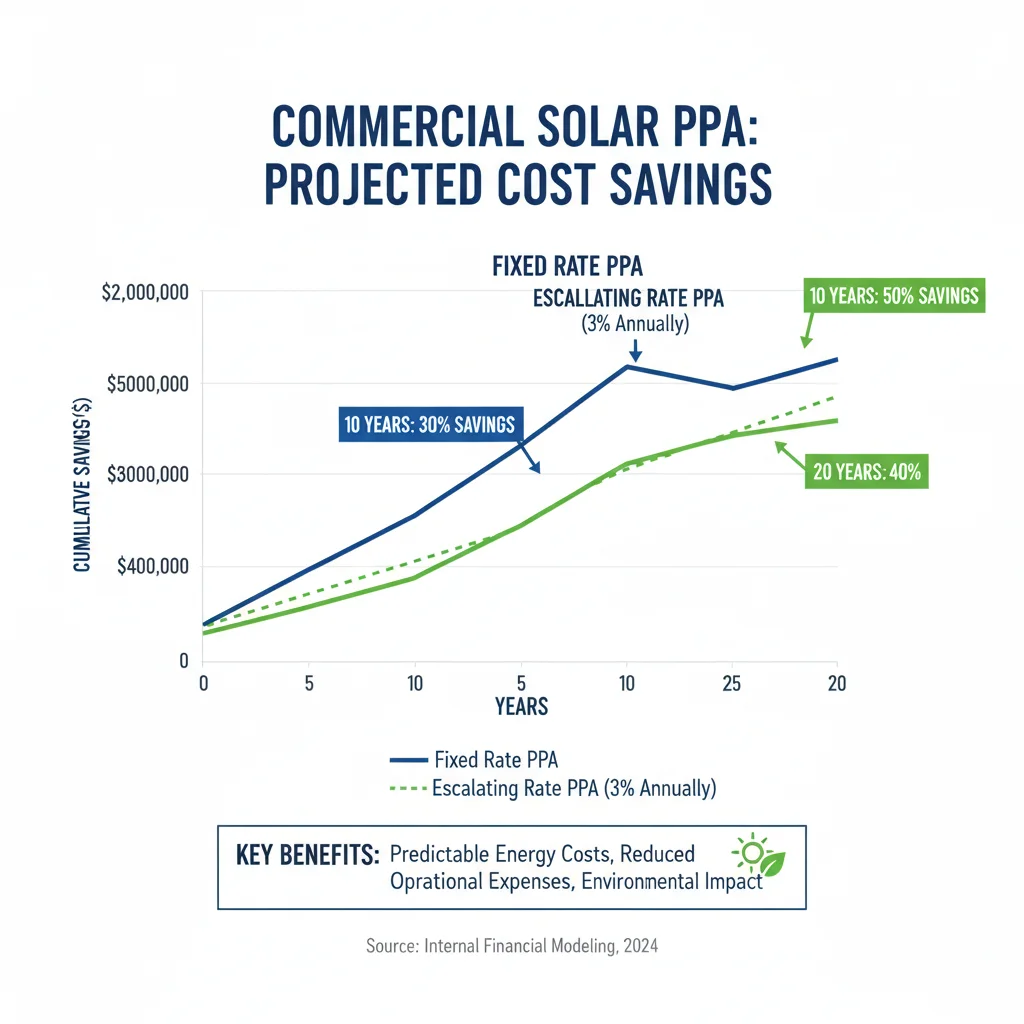
Example Scenario (Hypothetical for 2026):
Imagine a business with an average electricity consumption of 100,000 kWh/month. Their current utility rate is $0.15/kWh, and it’s projected to increase by 3% annually.
- Fixed-Rate PPA Offer: $0.12/kWh for 20 years.
- Escalating-Rate PPA Offer: $0.10/kWh in year 1, escalating by 2% annually for 20 years.
A detailed spreadsheet analysis would show:
- The fixed-rate PPA provides immediate savings of $0.03/kWh ($3,000/month or $36,000/year). These savings remain constant.
- The escalating-rate PPA provides even greater immediate savings of $0.05/kWh ($5,000/month or $60,000/year). However, this rate will slowly increase.
- The crossover point: At some point, the escalating PPA rate will exceed the fixed PPA rate. More importantly, you need to determine when each PPA rate will exceed the projected utility rate.
- NPV analysis will ultimately reveal which option provides the greatest financial benefit over the entire contract term, taking into account the time value of money.
Such modeling is critical for a truly informed decision on your commercial solar PPA.
The Role of Market Trends and Technology in 2026
The commercial solar PPA market in 2026 will continue to be shaped by several key trends:
- Decreasing Hardware Costs: While the pace of solar panel cost reduction has slowed, efficiency improvements continue, leading to more power per panel and lower overall system costs.
- Battery Storage Integration: The integration of battery storage with commercial solar is becoming more common. This can enhance the value proposition of a PPA by providing energy resilience and allowing for demand charge management, potentially influencing PPA rates.
- Advanced Analytics and Monitoring: Sophisticated monitoring systems offer real-time insights into system performance, ensuring optimal generation and enabling proactive maintenance, which benefits both the developer and the host business.
- Policy and Regulatory Environment: Federal and state policies, including tax incentives, renewable energy mandates, and net metering rules, will continue to play a significant role in shaping the attractiveness and financial viability of PPAs. Businesses must stay abreast of these developments.
- Corporate Sustainability Initiatives: More companies are setting ambitious renewable energy targets, driving demand for PPAs as a straightforward way to meet these goals.
These trends can indirectly influence the PPA rates offered by developers. For instance, if battery storage becomes a standard offering with PPAs, it might slightly increase the initial PPA rate but offer greater long-term value through enhanced energy management.
Negotiating Your Commercial Solar PPA in 2026
Regardless of whether you lean towards a fixed or escalating rate, effective negotiation is key to securing the most favorable PPA terms. Here are some tips for 2026:
- Solicit Multiple Bids: Always get proposals from at least three different reputable solar PPA providers. This creates competition and gives you leverage.
- Understand All Terms: Go beyond just the rate. Scrutinize the contract length, performance guarantees, maintenance responsibilities, termination clauses, and end-of-term options.
- Engage Legal Counsel: Have an attorney specializing in energy contracts review the PPA document before signing. They can identify potential pitfalls and ensure your interests are protected.
- Be Prepared to Negotiate: Don’t assume the first offer is the best. Be ready to negotiate on the rate, escalation percentage, contract length, and other terms.
- Clarify Performance Guarantees: Ensure the PPA includes clear performance guarantees and remedies if the system underperforms. This is crucial for both fixed and escalating rate agreements.
- Consider Your Energy Profile: Share detailed information about your business’s energy consumption patterns with potential providers. This helps them design a system and offer a PPA that best fits your needs.
Conclusion: Making the Right Commercial Solar PPA Choice for Your Business in 2026
Choosing between a fixed and an escalating rate commercial solar PPA is a strategic decision that will impact your business’s financial health for decades. Both options offer distinct advantages and disadvantages, and the ‘better’ choice depends entirely on your organization’s specific priorities, financial outlook, and risk appetite.
In 2026, fixed-rate PPAs will continue to appeal to businesses seeking maximum budget certainty and protection against utility price volatility. They offer simplicity and a clear path to predictable energy costs. On the other hand, escalating-rate PPAs will attract those looking for lower initial costs and greater early-stage savings, provided they are comfortable with a gradual increase in rates over time and believe these increases will be outpaced by conventional utility price hikes.
The key to success lies in conducting a thorough financial analysis, projecting future utility rates, understanding all contractual terms, and seeking expert advice. By carefully evaluating these factors, businesses can confidently select the PPA structure that best aligns with their long-term financial goals and commitment to sustainable energy. Embracing solar through a well-structured PPA is not just an environmental statement; it’s a smart business move that can deliver significant economic benefits for years to come.